When ego is scorched: The aftermath of wildfire

"When the flames are gone, healing begins with rebuilding not just homes, but the sense of safety and belonging they once held."
— By Divya Guha
The strongest emotion when you watch your home and the landscape turn to ash is helplessness. Wildfire is unlike many other traumatic events because we rarely survive only one loss. Within hours, we may lose our home, treasured possessions, livestock, livelihood, financial security, neighbourhoods, routines and the reassuring belief that tomorrow will resemble yesterday. Children may lose schools, pets, playgrounds and the predictability that makes the world feel safe. Psychologists sometimes describe this as cumulative loss.
A wildfire dismantles the ordinary architecture of life, disrupting almost every system that makes it feel ordinary.
Families keep ‘go bags’ by the door, never knowing when they might return, if ever. Those just outside evacuation zones endure a different kind of torment: waiting. Like the pandemic, it creates a peculiar limbo filled with emergency alerts, but also smoke columns on the horizon and fires that change direction unpredictably. Every passing emergency vehicle raises questions. The air itself becomes something to fear. Fine particulate pollution from wildfire smoke makes it unsafe to breathe comfortably. Electricity is deliberately cut to reduce the risk of new fires. Toxic ash settles on gardens and rooftops, and residents are advised not to touch it until rain has washed it away because it may contain heavy metals, asbestos and other hazardous materials.
Even after evacuation, uncertainty may continue as families spend months in hotels or temporary accommodation while navigating insurance claims, planning permissions and get about the slow business of rebuilding. Others await discovering if their workplaces remain standing. Farms burn, restaurants close, small businesses lose both their premises and customers, and jobs disappear along with the buildings. Housing shortages push up rents even as strangers offer spare rooms and community halls become shelters. Disaster reveals extraordinary generosity, but also uncomfortable inequalities.
Wildfires are natural disasters, but increasingly they are also psychological ones. For many, these difficulties persist long after the flames were extinguished and homes rebuilt, suggesting that recovery is measured not only in bricks and mortar, but in the slower work of rebuilding an inner world that suddenly feels unfamiliar.
European wildfire season is getting longer and hotter, extending beyond the Mediterranean into countries that historically considered themselves too wet to burn. The European Environment Agency reports that serious wildfires are spreading northwards into regions including Sweden, Germany, and the Netherlands. Unlike Australians or Californians, they have grown up assuming wildfire happens elsewhere. Firefighting services say they have seen their busiest days since the Blitz.
Home, the place that once regulated our nervous system, no longer feels safe and, for a time, it isn’t. We must relearn how to feel at home in an alien landscape. And most of us think of loss as losing people and are unaccustomed to thinking about losing places. But what is a place when it is a part of you? And then to lose it.
Psychologists have long recognised that human beings form deep emotional bonds not only with other people. It can be a familiar footpath, or where the sun falls at dusk, the purple flush of heather on a hillside in summer. The background we realise had oriented and reassured us or told us we were home. Environmental psychologists call this place attachment mingled with memory and identity.
Solastalgia
The famous Kinder Scout Mass Trespass of 1932 was a defining moment in Britain’s campaign for public access to the countryside and ultimately helped inspire today’s network of national parks and rights of way. For many people, moorland therefore symbolises not only nature but democratic access to it.
To someone outside Britain, the heath or the moors may appear little more than open scrub. But to Britons they are woven into their cultural imagination.
Australian environmental philosopher Glenn Albrecht coined the term solastalgia to describe the distress people experience when the place they call home is transformed while they are still living there. Unlike nostalgia, the sadness of leaving somewhere familiar, solastalgia is the grief of remaining in place only to find that the place has become unrecognisable.
The European Environment Agency reports that wildfire seasons are growing longer and spreading northwards into Sweden, Germany, the Netherlands and the United Kingdom. Britain’s fires may be smaller than those in Australia or California, but they carry a different psychological weight because they occur in landscapes many people never imagined could burn.
Mourning a landscape
The Yorkshire moors are inseparable from Emily Brontë’s Wuthering Heights. The Pennines, the North York Moors and the Scottish Highlands are places for walking, birdsong, family holidays and solitude. Commons, meadows and grasslands are where families gather with children and dogs on warm evenings. Their value lies not only in their beauty, but also familiarity.
When these places burn, we miss a view from the kitchen window, hear silence instead of birdsong, or woodland paths reduced to blackened earth. The loss feels personal, never simply of the scenery; these are our psychological landmarks.
Neurologists say our brains use familiar environments for orienting and these internal maps are traced around the people and the places we love. After a wildfire, survivors often describe feeling disorientated even after they return home. A house may be rebuilt, but an ancient oak has gone. A garden blooms again while the woodland beyond has disappeared. The map must be redrawn but belonging can take years.
What wildfire does to the brain and body
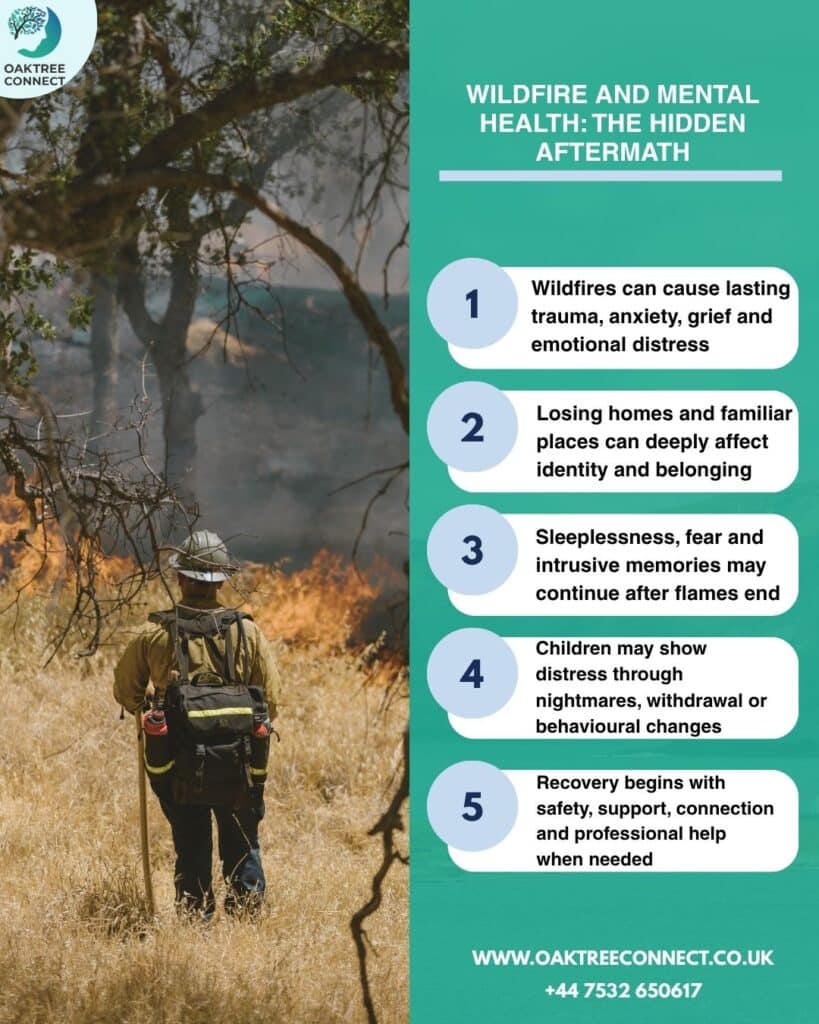
Not everyone who lives through a wildfire will develop a mental health condition. One of the most important findings in disaster psychology is that resilience is the most common outcome.
Many people experience fear, sleeplessness, intrusive memories and grief before gradually adapting to their new reality. Distress, however profound, is not in itself a sign of mental illness.
For others, recovery is more difficult. A meta-analysis of 33 international studies found that around one in four wildfire survivors developed clinically significant symptoms of post-traumatic stress disorder (27%), depression (29%) or anxiety (25%), with symptoms often persisting for months after the fire. Recovery frequently takes longer than rebuilding homes.
Children deserve particular attention because they do not always express distress in the same way as adults. Some become unusually clingy or fearful of separation. Others develop nightmares, become irritable, struggle to concentrate at school or repeatedly recreate the disaster in their play. Adolescents may withdraw, become angry or appear emotionally numb. These are understandable responses to extraordinary circumstances rather than signs of permanent psychological harm. What children need most is not perfect reassurance but honest explanations, familiar routines, patient adults and the permission to ask the same difficult questions many times over.
Psychological First Aid
One of the most significant developments in disaster psychiatry has been recognising that the best immediate psychological support is often surprisingly ordinary. Earlier approaches encouraged survivors to recount traumatic experiences soon after a disaster in the hope of preventing later psychological problems. The evidence has not supported this. Instead, international guidelines recommend Psychological First Aid.
It begins with practical rather than psychological questions. Are people physically safe? Do they have somewhere to sleep? Can they breathe clean air? Have families been reunited? Do they have accurate information about what happens next? The aim is not to relive frightening experiences but to restore safety, calm, connection and a sense of control.
In the first days after a wildfire, some of the most therapeutic interventions are remarkably simple: a hot meal, a familiar face, reliable information, clean clothing, a place to charge a mobile phone or meaningful work such as helping neighbours, sorting donations or caring for animals. These acts remind people they are not powerless and that recovery is possible.
For those whose distress remains intense or begins interfering with everyday life, specialist therapy can make a meaningful difference. The strongest evidence supports trauma-focused cognitive behavioural therapy (CBT). Other approaches, including Eye Movement Desensitisation and Reprocessing (EMDR), mindfulness-based therapies and grief-focused interventions, may also be appropriate depending on an individual’s experiences and symptoms.
Perhaps the most reassuring message from the research is this: seeking help does not mean you have failed to cope. Therapy cannot erase what happened, but it can help people understand why minds and bodies are responding as they are.
In the Hindu, or Shaivite, tradition, Shiva is associated with destruction, but not for its own sake. Fire clears away what can no longer remain so that something different may eventually emerge. It is an uncomfortable idea because, in the immediate aftermath of catastrophe, there is no transformation to admire. There are only ashes, exhausted firefighters, frightened children. Renewal is the last chapter, not the first.
There is also an old saying that forests remember. Ecologists know this to be true. Some seeds remain dormant until intense heat cracks their protective shells, while others germinate in soil enriched by ash. The landscape is altered forever, yet life slowly returns. Human beings are not forests, but there is something hopeful in the metaphor. Recovery does not ask us to become who we were before the fire; it asks whether we can learn to inhabit who we have become afterwards.
After the Great Fire of 1666 for months London was a place of smoke, rubble and uncertainty but regained a shape that was better prepared for the future. Psychological recovery follows a similar rhythm. Therapy cannot restore yesterday, nor does it ask to pretend nothing has changed but make sense of what happened, understand why minds and bodies continue to react after the danger has passed, and build a life in which fear is no longer the architect of every decision.
Perhaps that is what healing looks like: finding a path redrawn by fire. When all we can see are the ashes, therapy can help the human soul remain congruent.
References
Albrecht, G. (2005). ‘Solastalgia’: A new concept in health and identity. PAN: Philosophy, Activism, Nature, 3, 41–55.
Bonanno, G. A. (2004). Loss, trauma, and human resilience: Have we underestimated the human capacity to thrive after extremely aversive events? American Psychologist, 59(1), 20–28. https://doi.org/10.1037/0003-066X.59.1.20
Bonanno, G. A. (2021). The End of Trauma: How the New Science of Resilience Is Changing How We Think About PTSD. Basic Books.
Forresi, B., et al. (2026). Wildfires and Mental Health in Adults and Youth: A Meta-analysis of Prevalence Estimates.
Hobfoll, S. E., Watson, P., Bell, C. C., Bryant, R. A., Brymer, M. J., Friedman, M. J., Friedman, M., Gersons, B. P. R., de Jong, J. T. V. M., Layne, C. M., Maguen, S., Neria, Y., Norwood, A. E., Pynoos, R. S., Reissman, D., Ruzek, J. I., Shalev, A. Y., Solomon, Z., Steinberg, A. M., & Ursano, R. J. (2007). Five essential elements of immediate and mid-term mass trauma intervention: Empirical evidence. Psychiatry, 70(4), 283–315. https://doi.org/10.1521/psyc.2007.70.4.283
O’Connor, M.-F. (2022). The Grieving Brain: The Surprising Science of How We Learn from Love and Loss. HarperOne.
Environmental psychology and place attachment
Scannell, L., & Gifford, R. (2010). Defining place attachment: A tripartite organising framework. Journal of Environmental Psychology, 30(1), 1–10.
Lewicka, M. (2011). Place attachment: How far have we come in the last 40 years? Journal of Environmental Psychology, 31(3), 207–230.
Disaster mental health
World Health Organization, War Trauma Foundation, & World Vision International. (2011). Psychological First Aid: Guide for Field Workers.
National Child Traumatic Stress Network, & National Center for PTSD. (2006, revised 2018). Psychological First Aid: Field Operations Guide (2nd ed.).
Wildfire and disaster psychology
Bryant, R. A., et al. (2024). Cognitive Behavioural Therapy versus Mindfulness for Prolonged Grief Disorder.
Psychological interventions for grief in adults: A systematic review and meta-analysis of randomised controlled trials. (2019). Journal of Affective Disorders, 253, 69–86.
Reports
European Environment Agency. (2024). European Wildfire Risk Assessment (or the latest wildfire report you consulted).
Forest Research. (2024). Wildfires in the UK: Statistics and Trends.
London Fire Brigade. (2022). Wennington Wildfire Incident Report.
Literature cited
Wuthering Heights. Emily Brontë. (1847).
Disorder Related Blogs
- Anorexia Nervosa: Recognise the Quiet Killer
- Patient Talk - What Does Severe Clinical Depression Feel Like?
- Dear Mum: A Story by an Oaktree Patient with Depression
- SCHIZOPHRENIA – A Poem
- Autism: Dispelling Myths
- Mental Fitness: “I Have an Addiction”
Lifestyle Related Blogs
- Preventing Online Burnout
- Sad at Christmas? Help Is at Hand
- Burnout at Work
- Mental Fitness: How to Beat Stress
- Mental fitness: Brain Stimulation Therapy
- Mental Fitness: When Should You Stop Driving?
- Mental Fitness: “Let Us Talk About It”
- How to Combat Work-Related Stress
- Foods that make you happy
- Business Spending on Mental Health, Worth it?
- Employers Need More Awareness of Mental Health Issues
Other Blogs
Are you a leader and need mentoring or coaching? We may be able to help. Contact us at contact@oaktreeconnect.co.uk.

Author: Divya Guha
Divya is a journalist and editor with over two decades’ experience writing on diverse topics including mental health, grief and contemporary social issues drawing on academic research and expert perspectives. Her work is research-driven and aims to make complex ideas accessible. She holds an MA in Journalism from Goldsmiths College, London.
Contact:
Email – clinicadmin@oaktreeconnect.co.uk
Telephone – 020 39277699
Recent Blogs







Oaktree Connect Fees & Pricing for Other Services
There may be additional fees payable after your assessment, for which you will receive an invoice: for example, for the costs for prescribing medication agreed between you and the psychiatrist at the time of assessment. We try our utmost to stay within the time allocated for the appointment however, you could be charged for any extra time spent in the consultation, if the meeting runs over the allocated time, or where communications with you or reviewing notes etc. exceeds what is deemed reasonable, but this is at the discretion of the clinician.