Beyond burnout: Returning to the self

"Helplessness, impossible demands and the return to wholeness."
— By Dr Meetu Singh
Do you feel persistently overwhelmed, exhausted, irritable or unlike yourself? Stress can come from work, caring for someone, family conflict, illness, money worries, uncertainty, or several pressures at once?
Burnout has become a familiar word for many kinds of depletion. Strictly speaking, it describes chronic stress connected with work. Similar feelings can occur outside employment, however, and the label matters less than understanding the pattern: what is placing you under strain, how long it has continued, and whether you are still able to recover.
In a wide-ranging 2024 review, occupational psychologist Evangelia Demerouti examines how burnout is defined and measured, how it overlaps with fatigue, anxiety and depression, which working conditions contribute to it, and what kinds of intervention help. One practical message is that questionnaires can be useful for identifying and tracking symptoms, but a score is not a diagnosis. Clinicians consider the full picture: your history, symptoms, physical health, daily functioning and the way the problem has developed over time.
When stress stops being helpful
Stress is not always harmful. In a short emergency, it helps us focus and act. Robert Sapolsky’s memorable book title Why Zebras Don’t Get Ulcers captures the basic idea: a zebra responds intensely while escaping a predator, then settles when the danger has passed. Human beings can keep the same alarm response going through anticipation, worry, rumination and demands that return day after day (Sapolsky, 2004).
When there is too little recovery, stress can show up in different ways. Some people feel constantly ‘wired’: tense, watchful, irritable and unable to sleep. Others feel depleted: slowed down, forgetful, indecisive or unable to enjoy things. You may become detached from work or from people you care about, or feel that you are functioning on autopilot.
People sometimes describe reaching a point of ‘collapse’. This is not one specific medical event. It usually means that ordinary functioning has become unexpectedly difficult. A person may be unable to get through the working day, make simple decisions or keep up with daily tasks. Sleep may become disrupted; tears, panic, anger or emotional numbness may appear; headaches, muscle tension, dizziness or palpitations may become more noticeable. This is a sign to seek support, not a personal failure.
Why control and recovery matter
Repeated, uncontrollable stress can reduce the expectation that anything you do will make a difference. This is the idea behind learned helplessness. Modern neuroscience has refined the original theory. Maier and Seligman argued that passivity may be a basic response to prolonged, uncontrollable stress, while the experience of having some control is what the brain learns and uses to regulate that response (Maier & Seligman, 2016). Much of the detailed brain research comes from animals, but the everyday lesson is simple: choice, predictability and support can change how a demand is experienced.
Ideas about hard work also shape our response to stress. Max Weber wrote about the modern work ethic and the long cultural association between disciplined labour and virtue. Hard work can bring dignity, purpose and achievement. The difficulty comes when effort becomes the main proof of a person’s worth and rest begins to feel like a moral failure.
This is more than a philosophical point. Across eight studies involving 5,502 participants, Celniker and colleagues found that people who appeared to work harder were judged as more moral and desirable as partners, and sometimes received more pay or donations—even when the extra effort added no practical value (Celniker et al., 2023). The finding does not mean that effort is bad. It reminds us that visible suffering is not a reliable measure of commitment, character or usefulness.
When life feels like spinning straw into gold
The fairy tale of Rumpelstiltskin offers a useful picture of an impossible demand. A miller tells the king that his daughter can spin straw into gold. She is expected to achieve something no person could reasonably do, and every solution carries a hidden price. Many people recognise the feeling, even when their circumstances are less dramatic: the target keeps moving, the responsibilities exceed the available time, or everyone depends on them being endlessly capable.
The story is a prompt to ask practical questions. Is the demand realistic? Are enough time, information and support available? What is being sacrificed to keep meeting it? Which part can be shared, postponed, renegotiated or stopped?
Demerouti distinguishes between person-focused approaches, which strengthen coping and psychological resources, and context-focused approaches, which reduce the source of stress. Therapy, relaxation, sleep support and problem-solving may help the individual. Changes to workload, boundaries, caring arrangements, communication or practical assistance may help the situation. Often the most useful plan includes both.
Chronic stress does more than consume energy. It can gradually narrow a life. The apparently optional things often go first: music, friendship, exercise, play, intimacy and unstructured time. Each choice may seem sensible on its own. Together, they remove the experiences through which you recognise yourself as “I am tired” can slowly become “I am no longer myself.”
What can help?
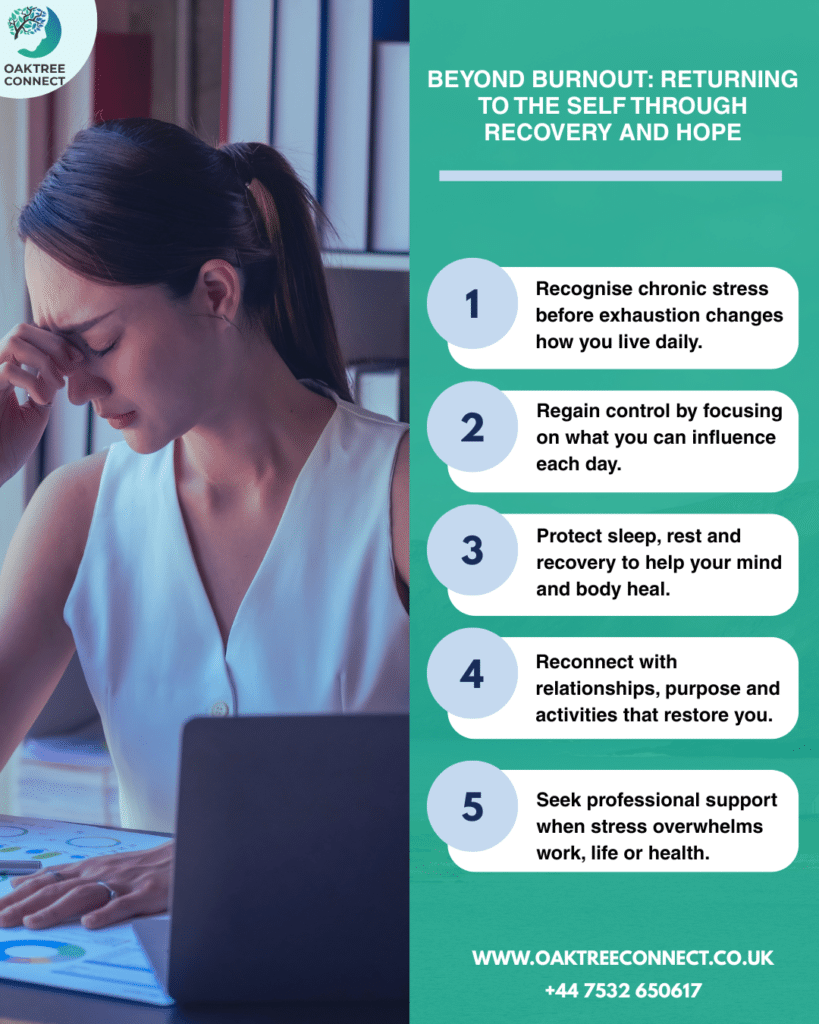
Name the main pressure. Try to separate what is urgent from what merely feels urgent, and what you can influence from what you cannot. A trusted person or therapist can help if everything feels tangled together.
Protect genuine recovery. Recovery is more than collapsing between periods of effort. Regular sleep, meals, movement, silence and time away from demands give the nervous system repeated signals that it is safe to stand down.
Restore connection and identity. Choose one small activity or relationship that existed before life became dominated by obligation. The aim is not another achievement. It is to make room for interest, pleasure, care and belonging.
Seek professional help when you need it. Consider speaking with a GP, psychiatrist or psychologist if symptoms persist, worsen or interfere with work, relationships, sleep or self-care. Psychiatrists are trained to distinguish ordinary stress from conditions that may need treatment, such as depression, anxiety or trauma-related illness, while also considering physical health, medication and substance use. The result may be practical advice, psychological therapy, medication, changes to your circumstances, or a combination.
If you feel unable to keep yourself safe or are thinking of harming yourself, seek urgent help from local emergency services or a crisis service.
The opposite of chronic stress is not simply rest. It is a life that once again contains enough safety, agency, connection and meaning. Recovery begins by recognizing that you are not failing at an impossible task—and that support can help you find a workable way forward.
Selected sources
Demerouti, E. (2024). “Burnout: a comprehensive review.” Zeitschrift für Arbeitswissenschaft, 78, 492–504. Open article
Celniker, J. B., Gregory, A., Koo, H. J., Piff, P. K., Ditto, P. H., & Shariff, A. F. (2023). “The moralization of effort.” Journal of Experimental Psychology: General, 152(1), 60–79. Open article
Maier, S. F., & Seligman, M. E. P. (2016). “Learned helplessness at fifty: Insights from neuroscience.” Psychological Review, 123(4), 349–367. Open article
Sapolsky, R. M. (2004). Why Zebras Don’t Get Ulcers: The Acclaimed Guide to Stress, Stress-Related Diseases, and Coping (3rd ed.). Holt Paperbacks. Publisher page
Guidi, J., Lucente, M., Sonino, N., & Fava, G. A. (2021). “Allostatic load and its impact on health: A systematic review.” Psychotherapy and Psychosomatics, 90, 11–27. Open article
Image credit and reuse
Ford Madox Brown, Work (1852–1865), Birmingham Museums Trust. Public-domain reproduction via Wikimedia Commons
Disorder Related Blogs
- Anorexia Nervosa: Recognise the Quiet Killer
- Patient Talk - What Does Severe Clinical Depression Feel Like?
- Dear Mum: A Story by an Oaktree Patient with Depression
- SCHIZOPHRENIA – A Poem
- Autism: Dispelling Myths
- Mental Fitness: “I Have an Addiction”
Lifestyle Related Blogs
- Preventing Online Burnout
- Sad at Christmas? Help Is at Hand
- Burnout at Work
- Mental Fitness: How to Beat Stress
- Mental fitness: Brain Stimulation Therapy
- Mental Fitness: When Should You Stop Driving?
- Mental Fitness: “Let Us Talk About It”
- How to Combat Work-Related Stress
- Foods that make you happy
- Business Spending on Mental Health, Worth it?
- Employers Need More Awareness of Mental Health Issues
Other Blogs
Are you a leader and need mentoring or coaching? We may be able to help. Contact us at contact@oaktreeconnect.co.uk.

Author: Dr Meetu Singh
Dr Singh is the consultant psychiatrist with a special interest in neuropsychiatry. Having seen and treated hundreds of patients with ADHD, in London and Birmingham and with masters in Neuropsychiatry, she is well known as an expert in this field.
Contact:
Email – clinicadmin@oaktreeconnect.co.uk
Telephone – 020 39277699
Recent Blogs







Oaktree Connect Fees & Pricing for Other Services
There may be additional fees payable after your assessment, for which you will receive an invoice: for example, for the costs for prescribing medication agreed between you and the psychiatrist at the time of assessment. We try our utmost to stay within the time allocated for the appointment however, you could be charged for any extra time spent in the consultation, if the meeting runs over the allocated time, or where communications with you or reviewing notes etc. exceeds what is deemed reasonable, but this is at the discretion of the clinician.