
HIV Has Changed. Has Our Psychology Caught Up?

"HIV may be medically manageable today, but living well with it still requires understanding, acceptance and psychological care."
— By Divya Guha
In 2024, an estimated 114,000 adults were living with HIV whose treatment has transformed what it means to live with the virus. The country has achieved the UNAIDS 95-95-95 targets: 95% of people living with HIV were estimated to have been diagnosed, 95% of those diagnosed were receiving treatment, and 98% of people on treatment had an undetectable viral load.
In other words, to have the virus is no longer necessarily the beginning of a life-threatening illness and can mean living for decades with a manageable long-term condition. Yet the psychological experience of HIV has not necessarily changed at the same pace as its medical prognosis.
Someone can be physically well, taking effective treatment and have an undetectable viral load, while still wondering whom they can tell, whether a partner will reject them, whether friends or colleagues will find out, or how the diagnosis has changed the way they see themselves.
The British HIV Association (BHIVA) recognised this gap when it published Standards of Psychological Support for Adults Living with HIV in 2024 which note that the remarkable progress of the biomedical treatment of HIV has not been matched by equivalent progress in addressing the mental health and wellbeing of those living with it.
BHIVA describes emotional wellbeing as encompassing the lived experience of HIV. Mental-health difficulties are more specific and may or may not include depression, anxiety, PTSD, sleep difficulties, substance misuse, self-harm and suicidal thoughts.
Afterall, feeling distressed about a diagnosis is not necessarily depression. Worrying about disclosure is not necessarily an anxiety disorder. Wanting to withdraw after experiencing discrimination does not automatically mean that someone has a mental illness. But these experiences can take a psychological toll.
Disclosure can be particularly complicated. A person may know that effective treatment can make HIV sexually untransmittable when the viral load remains undetectable, the principle known as U=U, or Undetectable = Untransmittable, while still fearing that a potential partner will react to the word HIV rather than to the medical reality.
That can create a peculiar form of loneliness: the knowledge that something fundamental about your life is not something you can easily discuss with everyone around you.
Psychological support can provide a place where these questions can be explored without reducing them to symptoms: Who do I tell? What am I afraid will happen? What does this diagnosis mean to me? What kind of life do I believe is still possible?
Sometimes the task is not to eliminate uncertainty, but to find a way of living alongside it.
Two generations, two psychological histories
The experience of someone diagnosed with HIV today can be radically different from that of someone diagnosed in the 1980s or 1990s.
For a younger person newly diagnosed, questions may centre on identity, sex, dating, disclosure, marriage, children, work and the future. They may have grown up knowing that HIV is treatable, yet encounter misconceptions and stigma that belong to an earlier era.
For someone who has lived with HIV for several decades, the psychological history may be very different. They may have watched partners or friends become seriously ill or die during the AIDS epidemic. They may have spent years believing that they would not live to old age. They may now be confronting the strange psychological task of outliving the future they once expected.
And England’s HIV population is increasingly an ageing population. In 2024, 52% of people receiving HIV care were aged 50 or over, compared with 32% in 2015.
Ageing with HIV can therefore bring its own concerns: loneliness, bereavement, retirement, financial insecurity, other long-term health conditions, changing relationships and sexuality, and the question of whether to disclose HIV to new people entering one’s life.
These experiences should not be assumed to produce mental illness. Some people adapt remarkably well. Others may find that an old diagnosis acquires a new emotional significance at different stages of life.
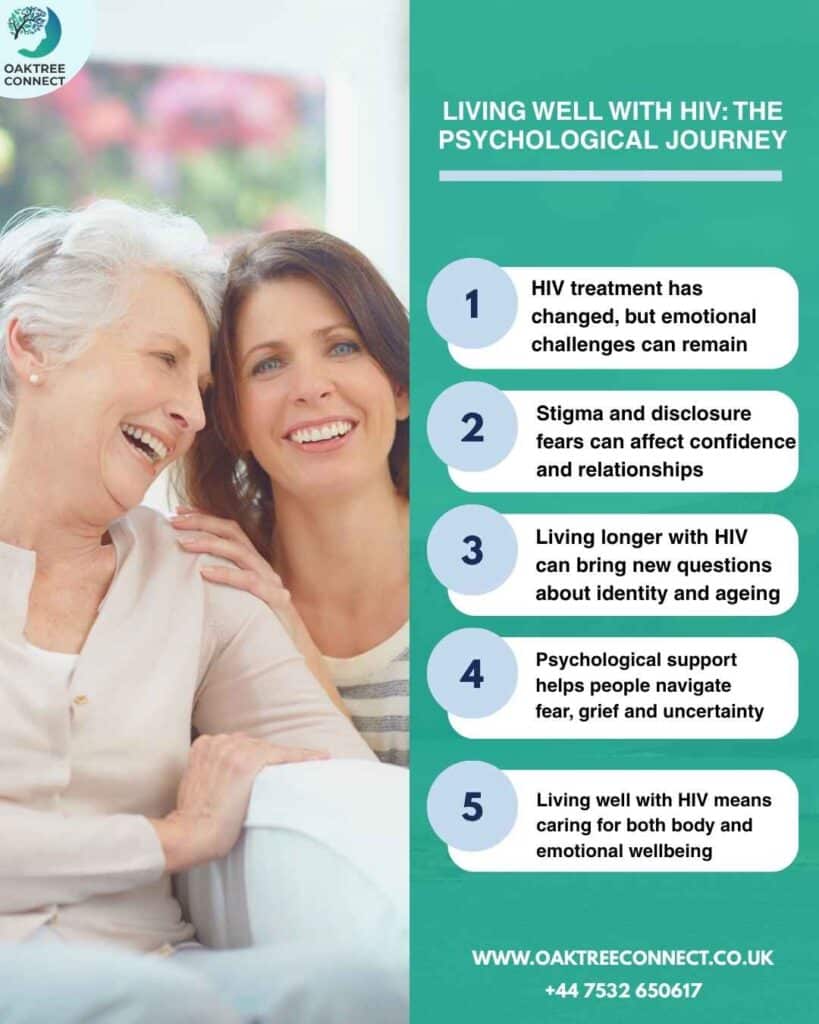
There is no single psychological experience of HIV
HIV is unusual among long-term physical conditions in having specific British standards that explicitly embed psychological assessment and support within HIV care.
BHIVA recommends that people living with HIV have their mental health assessed at least annually and following potential trigger events, with assessment covering areas including depression, anxiety, PTSD, sleep, addictions, self-harm and suicidal thoughts. The model is intended to be stepped: HIV teams identify difficulties and provide or arrange appropriate support, while people with more substantial problems can be referred for specialist psychological or psychiatric care.
This does not mean that everyone living with HIV needs psychotherapy. Nor does it mean that HIV is uniquely psychologically damaging. Rather, it recognises that good HIV care involves more than controlling the virus.
Support can be individual or collective. Peer groups can be particularly valuable because they address something an individual therapist cannot always provide: the experience of meeting other people who simply understand what it means to live with HIV.
A 2021 systematic review of 20 randomised controlled trials involving 7,605 people found that peer support modestly improved retention in HIV care and adherence to treatment, with some evidence of improved viral suppression. Evidence for specific improvements in mental health was more limited.
There is also a growing evidence base for psychological interventions themselves. A 2025 systematic review identified 67 randomised controlled trials of psychosocial interventions among adults living with HIV in high-income countries, demonstrating the scale of research now being conducted into psychological as well as medical care.
Ultimately, the purpose of psychological support is not to make someone ‘positive’ about having HIV, nor to suggest that distress is a failure to cope.
It can provide somewhere to acknowledge guilt, shame, fear or anger; to understand the effects of stigma (a set of negative and unfair beliefs people have about something); to rebuild confidence and relationships; and to consider what is possible beyond the diagnosis.
When should someone seek psychological care?
Not everyone who feels upset, frightened or uncertain after an HIV diagnosis needs therapy. Difficult emotions can be a natural response to receiving a life-changing diagnosis, and people differ considerably in how they adjust.
Psychological support may become particularly important when distress persists, intensifies or begins to interfere with everyday life.
This might include persistent anxiety or low mood; withdrawing from friends, relationships or activities; difficulty sleeping; changes in motivation; problems coping with disclosure or relationships; using alcohol or drugs to manage difficult feelings; or feeling overwhelmed by shame, fear or hopelessness.
Thoughts of self-harm or suicide require more urgent professional help.
It can also be worth seeking support at moments of significant change: following diagnosis, after a change in health, during relationship difficulties or bereavement, or when the experience of living with HIV begins to feel different at another stage of life.
The aim is not necessarily to make difficult feelings disappear but offer a private space to understand what the diagnosis means to the individual, separate medical reality from inherited fears about HIV, and develop ways of living with uncertainty, stigma or difficult emotions.
How Oaktree Connect can help
For people who feel they would benefit from psychological support, Oaktree Connect offers a confidential space to explore the emotional and psychological aspects of living with HIV.
Therapy can be useful whether someone is struggling with a specific mental-health difficulty or simply finding that the experience of living with HIV has become difficult to navigate alone. Conversations may touch on identity, disclosure, relationships, stigma, self-esteem, grief, loneliness, anxiety or fears about the future.
The important point is that there is no single right way to feel about an HIV diagnosis. Some people may need intensive psychological support; others may want a limited number of sessions around a particular difficulty. What matters is having somewhere to talk when the psychological burden becomes difficult to carry alone.
HIV has changed dramatically as a medical condition. The challenge now is to ensure that the psychological and social experience of living with it receives the same attention.
The virus may be undetectable. But living well with HIV can still require care.
References
UK Health Security Agency (UKHSA). HIV testing, PrEP, new HIV diagnoses and care outcomes for people accessing HIV services: 2025 report.
British HIV Association (BHIVA). Standards of Psychological Support for Adults Living with HIV 2025
www.merriam-webster.com
Davey, C. et al. (2021). The effectiveness of peer-support for people living with HIV: A systematic review and meta-analysis.
PubMed: The effectiveness of peer-support for people living with HIV
UCL / Royal Free London et al. (2025). Evidence from high-income countries on the effectiveness of psychosocial interventions to improve mental health, wellbeing and quality of life for adults living with HIV: a systematic review and meta-analysis.
The review identified 67 randomised controlled trials conducted in high-income countries between 2008 and 2023.
PubMed: Psychosocial interventions for adults living with HIV in high-income countries
Disorder Related Blogs
- Anorexia Nervosa: Recognise the Quiet Killer
- Patient Talk - What Does Severe Clinical Depression Feel Like?
- Dear Mum: A Story by an Oaktree Patient with Depression
- SCHIZOPHRENIA – A Poem
- Autism: Dispelling Myths
- Mental Fitness: “I Have an Addiction”
Lifestyle Related Blogs
- Preventing Online Burnout
- Sad at Christmas? Help Is at Hand
- Burnout at Work
- Mental Fitness: How to Beat Stress
- Mental fitness: Brain Stimulation Therapy
- Mental Fitness: When Should You Stop Driving?
- Mental Fitness: “Let Us Talk About It”
- How to Combat Work-Related Stress
- Foods that make you happy
- Business Spending on Mental Health, Worth it?
- Employers Need More Awareness of Mental Health Issues
Other Blogs
Are you a leader and need mentoring or coaching? We may be able to help. Contact us at contact@oaktreeconnect.co.uk.

Author: Divya Guha
Divya is a journalist and editor with over two decades’ experience writing on diverse topics including mental health, grief and contemporary social issues drawing on academic research and expert perspectives. Her work is research-driven and aims to make complex ideas accessible. She holds an MA in Journalism from Goldsmiths College, London.
Contact:
Email – clinicadmin@oaktreeconnect.co.uk
Telephone – 020 39277699
Recent Blogs







Oaktree Connect Fees & Pricing for Other Services
There may be additional fees payable after your assessment, for which you will receive an invoice: for example, for the costs for prescribing medication agreed between you and the psychiatrist at the time of assessment. We try our utmost to stay within the time allocated for the appointment however, you could be charged for any extra time spent in the consultation, if the meeting runs over the allocated time, or where communications with you or reviewing notes etc. exceeds what is deemed reasonable, but this is at the discretion of the clinician.