
Looking for Autism’s Invisible Girls

"They are more likely to camouflage autistic traits in how attention, sensation and social life are experienced from the inside. The challenge for clinicians is learning to look beyond the painstaking mask."
— By Dr Meetu Singh
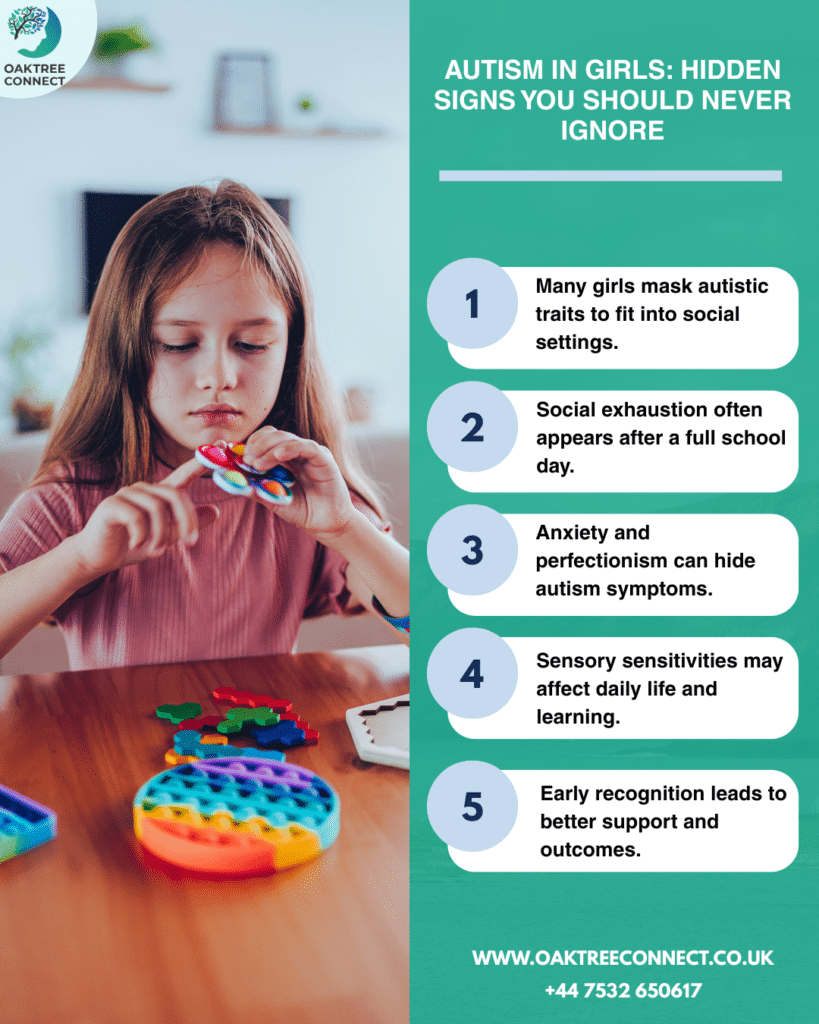
Autism is characterised by difficulties with how they respond to others, communicate, cope with change and experience the world. But autistic girls are more socially motivated than boys, so they may copy the behaviour of classmates to cope. In interviews they often appear to make better eye contact than autistic boys. At school they follow rules, get better grades, have a close friend, rehearse social responses and work hard at appearing socially adept, though they struggle and come home exhausted.
Clinical studies suggested that boys were diagnosed around three to four times more often than girls, though broader population studies showed the truer numbers were 3:1, indicating many girls missed or received expert attention late. Again studies revealed in fact they did, one to three years later, because of camouflaging their difficulties.
For decades girls were overlooked by science. For example, it was only in 2013 that atypical sensory differences became part of the formal diagnostic criteria revealing that many autistic people are unusually sensitive or under-sensitive to light, sound, smell, textures, pain or temperature.
Girls are also more likely to internalise distress than boys. Instead of drawing attention to themselves through disruptive behaviour, many present with anxiety, perfectionism, depression or eating disorders making autism less obvious to families, teachers and clinicians.
Autistic girls literally hide in plain sight
Manuals have remained overfocussed on social communication and repetitive behaviour. Autism was long seen as a ‘boy thing’, while girls were consistently underdiagnosed or misdiagnosed until much later, sometimes into their twenties, presenting instead with anxiety, depression, emotional difficulties and even suicidality.
A recent review of 56 studies done globally involving more than 13,000 autistic children and teens found girls experienced significantly higher anxiety symptoms than boys, with differences becoming more noticeable during adolescence and among those with higher IQ.
On the other hand, eating disorders are also disproportionately common among autistic girls and women compared with autistic males, although the relationship is still being investigated.
The caveat is that many available studies are predominantly gender-biased and that there can be many differences between autistic individuals, making interpretations less obvious.
For instance, girls may be fluent conversationalists but struggle academically. Others may experience periods of mutism under stress but show no obvious repetitive behaviours. The spectrum is broad, and relying on stereotypes inevitably leads to pitfalls.
British psychologist and autism researcher Wenn Lawson takes the view that monotropism, a tendency to focus deeply on one thing at a time, explains much of autism. He argues this is the common thread across boys and girls, although girls are often better at masking how it presents. Lawson believes monotropism is part of the underlying cognitive architecture of autism itself.
Experts also talk about interoception, the ability (or failure) to notice internal body signals such as hunger, thirst or anxiety.
Lawson also discusses object permanence. This is maintaining a sense that people or things continue to exist when they are no longer present and extends the concept beyond infancy. An autistic child may know intellectually that someone still exists when they leave the room but find it difficult to hold on to the emotional sense of that relationship without routines or reminders, such as photographs. Lawson believes this influences friendships, transitions and responses to change far more than clinicians have traditionally recognised.
Modern psychiatry has also acknowledged that these experiences rarely appear on behavioural checklists, yet they profoundly shape everyday life.
Clinicians may simply have been asking the wrong question. Instead of asking, What autistic behaviours does this girl display? Lawson suggests asking, How does this child’s mind organise attention? His argument is that behaviours such as masking, sensory overload, repetitive routines or intense interests are not random symptoms. They arise from the way an autistic person – whether a girl or boy – directs and sustains attention. Understanding that process helps explain why two children may behave very differently yet still meet the same diagnostic criteria.
Think spotlight, not floodlight, moonlight, not sunlight. An autistic child may become so absorbed in a task or sensation that everything else fades into the background.
Relationships and recovery
Don’t ask simply whether she has friends. Ask how she makes them, how she keeps them and what it costs her emotionally. That is the more contemporary clinical lens.
Childhood preoccupation can evolve into expertise in adulthood. Monotropism can later translate into exceptional focus. Obsessions become passions, allowing autistic people to process information with remarkable depth despite confusion around them.
These are the unique strengths of an autistic child navigating a world that expects her to appear effortless while she is trying extraordinarily hard simply to fit in.
Current evidence also shows that gender diversity co-occurs with autism more often than in the general population, though there is limited clarity as to why. When autism occurs alongside ADHD, it can create a push and pull between longing for sameness and craving novelty, making it difficult to maintain structure, and the psychological profile more complex. However, just as there is no distinct ‘girl autism’, there is no recognised transgender or LGBTQ+ autism phenotype.
A missed diagnosis has consequences beyond a label. Many girls spend years believing they are shy, lazy or socially inadequate. They may receive treatment for anxiety or depression without anyone recognising the autism beneath it. Some become exhausted by trying to meet social expectations that never came naturally. Understanding the underlying reason can change how families, schools and clinicians respond.
Thankfully, diagnosis is becoming more sophisticated because clinicians are asking better questions. Behaviour alone never tells the whole story, and the real clues often lie beneath the mask. Beyond the diagnosis, which is only the beginning,
How you can help your daughter
What matters next is helping but the first step may be the hardest: believing your daughter when she says she is tired. A girl who returns from school exhausted after appearing perfectly happy all day is not necessarily being dramatic or lazy. She may have spent the day monitoring her eye contact, conversation, facial expressions and body language while trying not to attract attention. Instead of asking only whether school was fun or if she has friends, ask if it was difficult to get through the day, if she felt she could be herself and what helped her cope. Listening without judgement is often more valuable than rushing to correct behaviour.
Schools also have an important role. Are timid children who never disrupt a class being overlooked?
Small adjustments make a difference: quieter spaces when the environment becomes overwhelming, short sensory breaks, routines, warning before changes, written as well as verbal instructions and teachers who understand that burnout or difficulties with time management are not signs of laziness or poor motivation.
A diagnosis should never become a limitation. For many, it brings enormous relief by explaining years of feeling different without knowing why. It can replace self-blame with self-understanding. Learning when to rest, recognising the early signs of overload, protecting time for interests that restore rather than drain energy and asking for reasonable adjustments are not signs of weakness. They are practical ways of staying well.
Autism is not simply a collection of deficits but recognise both the challenges and the strengths. Autistic girls no longer have to spend all their energy trying to appear effortless but given the space and time to succeed as themselves.
Disorder Related Blogs
- Anorexia Nervosa: Recognise the Quiet Killer
- Patient Talk - What Does Severe Clinical Depression Feel Like?
- Dear Mum: A Story by an Oaktree Patient with Depression
- SCHIZOPHRENIA – A Poem
- Autism: Dispelling Myths
- Mental Fitness: “I Have an Addiction”
Lifestyle Related Blogs
- Preventing Online Burnout
- Sad at Christmas? Help Is at Hand
- Burnout at Work
- Mental Fitness: How to Beat Stress
- Mental fitness: Brain Stimulation Therapy
- Mental Fitness: When Should You Stop Driving?
- Mental Fitness: “Let Us Talk About It”
- How to Combat Work-Related Stress
- Foods that make you happy
- Business Spending on Mental Health, Worth it?
- Employers Need More Awareness of Mental Health Issues
Other Blogs
Are you a leader and need mentoring or coaching? We may be able to help. Contact us at contact@oaktreeconnect.co.uk.

Author: Dr Meetu Singh
Dr Singh is the consultant psychiatrist with a special interest in neuropsychiatry. Having seen and treated hundreds of patients with ADHD, in London and Birmingham and with masters in Neuropsychiatry, she is well known as an expert in this field.
Contact:
Email – clinicadmin@oaktreeconnect.co.uk
Telephone – 020 39277699
Recent Blogs







Oaktree Connect Fees & Pricing for Other Services
There may be additional fees payable after your assessment, for which you will receive an invoice: for example, for the costs for prescribing medication agreed between you and the psychiatrist at the time of assessment. We try our utmost to stay within the time allocated for the appointment however, you could be charged for any extra time spent in the consultation, if the meeting runs over the allocated time, or where communications with you or reviewing notes etc. exceeds what is deemed reasonable, but this is at the discretion of the clinician.