
Managing Major Depressive Disorder with Private Psychiatric Care in the UK

"Depression is not simply low mood—it is a clinically recognised condition requiring careful assessment, accurate diagnosis, and a structured, doctor-led approach to treatment."
— Oaktree Connect
In clinical practice, Major Depressive Disorder remains one of the most frequently encountered yet often under recognised conditions in adult mental health. Many individuals describe a gradual erosion of energy, motivation, and emotional responsiveness, rather than a single identifiable moment of decline. Others present when functioning has already been significantly affected, often after months of attempting to manage symptoms independently.
Major Depressive Disorder is not simply a reaction to stress, nor is it a sign of personal weakness. It is a clinically defined condition, recognised within ICD 11 and DSM 5 TR frameworks, involving persistent changes in mood, cognition, and physical functioning. Understanding how it is assessed and managed within a structured, doctor led setting is essential in ensuring appropriate and effective care.
Understanding the Condition
Depression is best understood as a disorder that affects multiple domains of functioning simultaneously. Patients may describe low mood, but just as frequently report emotional blunting, loss of interest, reduced concentration, and physical symptoms such as fatigue or disrupted sleep.
From a diagnostic perspective, the presence of persistent low mood or loss of interest is central, accompanied by additional symptoms such as disturbed sleep, changes in appetite, impaired concentration, or feelings of guilt and worthlessness. These symptoms must be sustained and associated with functional impairment in daily life.
However, the clinical process extends beyond symptom recognition. A thorough assessment must consider whether the presentation is part of a unipolar depressive disorder or whether it may reflect an alternative or coexisting condition. For example, bipolar disorder may initially present with depressive episodes. Similarly, individuals with undiagnosed attention deficit hyperactivity disorder or autism spectrum conditions may present with secondary depressive symptoms related to long standing difficulties.
Physical health must also be considered. Conditions such as thyroid dysfunction, chronic pain, or neurological disorders may contribute to or mimic depressive presentations. In practice, this reinforces the importance of a comprehensive and medically informed assessment.
Why Diagnostic Clarity Is Essential
One of the most consistent themes observed over years of psychiatric practice is that difficulties in treatment often arise not from a lack of available interventions, but from an incomplete understanding of the underlying condition.
When depression is treated without sufficient diagnostic clarity, several issues may arise. Patients may be prescribed medication that is not well matched to their presentation. Psychological therapies may be offered without a clear formulation guiding their focus. In some cases, important coexisting conditions remain unrecognised, leading to partial or limited improvement.
For instance, where bipolar disorder is not identified, the use of antidepressant medication alone may not address the full clinical picture. Equally, where trauma related symptoms are prominent, a purely symptom focused approach may overlook underlying psychological processes that require targeted intervention.
A structured psychiatric assessment, conducted by a consultant psychiatrist, allows for a detailed exploration of these factors. When combined with input from an HCPC registered clinical psychologist, it becomes possible to develop a coherent formulation that informs treatment planning in a meaningful and individualised way.
At Oaktree Connect, this approach is central to care delivery. The clinical team brings together extensive experience across NHS and independent settings, with particular expertise in mood disorders, neuropsychiatry, and complex presentations .
Doctor Led Assessment at Oaktree Connect
Assessment within Oaktree Connect is designed to reflect established standards of psychiatric practice, with a focus on depth, clarity, and clinical safety.
Patients undergo a comprehensive evaluation that explores current symptoms in detail, alongside past mental health history, medical background, and relevant social factors. Particular attention is given to patterns over time, as well as any previous treatment responses. Risk is carefully assessed, including any history of self harm or suicidal thinking, in line with standard clinical protocols.
An important aspect of this process is the development of a psychological formulation. This moves beyond diagnosis alone, considering how biological, psychological, and social factors interact to maintain current difficulties. It is this formulation that guides subsequent treatment recommendations.
Where appropriate, further assessment may be indicated. This can include evaluation for attention deficit hyperactivity disorder or autism spectrum conditions, particularly where symptoms suggest long standing patterns that have not previously been recognised. In some cases, sleep disturbance, trauma, or occupational stress may also require more focused assessment. All services are delivered through secure online consultations, allowing access across England and Wales while maintaining clinical standards equivalent to in person care.
Treatment Approaches in Clinical Practice
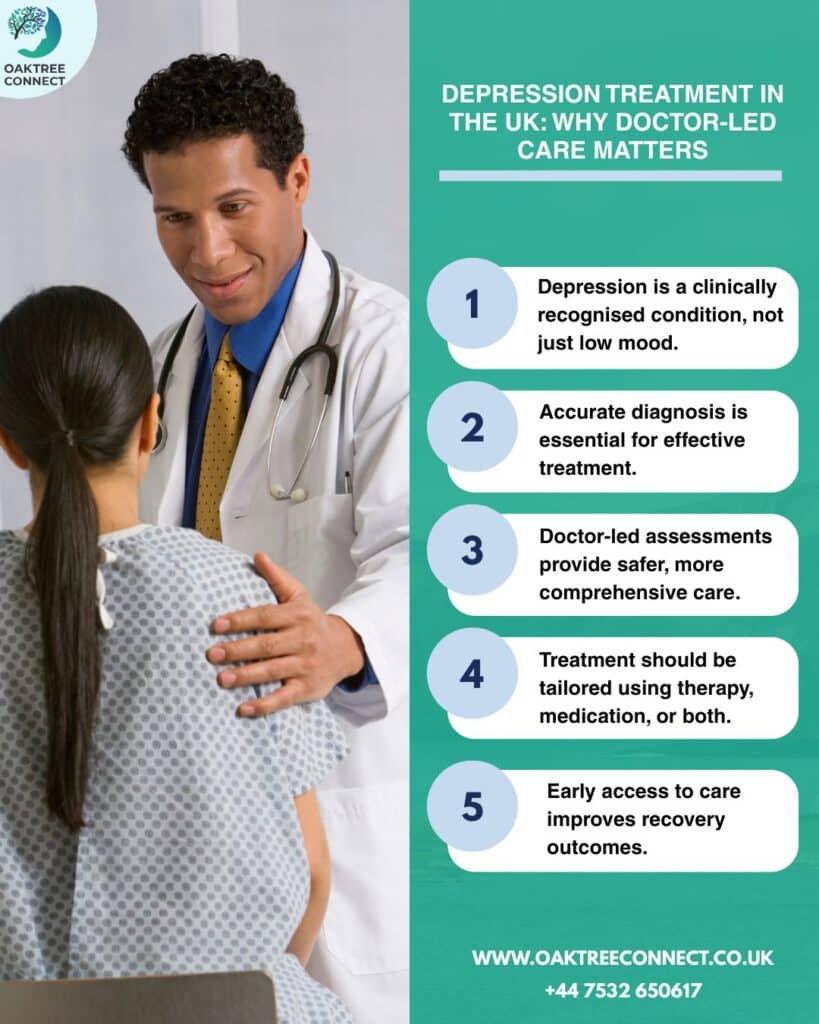
The management of Major Depressive Disorder requires a considered and individualised approach. There is no single treatment pathway that is appropriate for all patients, and decisions are guided by severity, duration, patient preference, and previous response to treatment.
Pharmacological treatment may be indicated where symptoms are moderate to severe, or where there has been limited response to psychological interventions. The role of medication is to address underlying neurochemical processes associated with mood regulation. However, prescribing is undertaken cautiously, with attention to potential side effects, interactions, and the individual’s broader clinical context. Ongoing monitoring and review form an essential part of this process.
Psychological therapy remains a central component of treatment. Cognitive Behavioural Therapy is widely used and supported by a strong evidence base, particularly in addressing patterns of negative thinking and behavioural withdrawal. For individuals with a history of trauma, more specialised approaches such as trauma focused therapy or EMDR may be indicated. Other modalities, including mindfulness based therapies and integrative approaches, may also be appropriate depending on the clinical formulation.
In cases where depression has not responded to standard treatments, neuromodulation techniques such as repetitive transcranial magnetic stimulation may be considered. This intervention targets specific brain regions involved in mood regulation and is offered following careful assessment to determine suitability.
In many instances, a combined approach involving both medication and psychological therapy provides the most comprehensive framework for recovery. Importantly, treatment is not static. It is reviewed and adjusted over time in response to clinical progress.
Accessing Private Psychiatric Care in the UK
Access to mental health services within the UK varies, and while the NHS provides essential care, waiting times and service availability can present challenges for some individuals.
Private psychiatric care offers an alternative pathway, particularly for those seeking timely assessment and continuity of care. Within this setting, patients are able to engage directly with consultant psychiatrists and clinical psychologists, allowing for a more consistent therapeutic relationship.
Oaktree Connect provides fully online services across the UK, combining accessibility with structured clinical care. The service includes comprehensive psychiatric assessments, ongoing medication management, and a range of evidence based psychological therapies . Transparent pricing and clearly defined care pathways allow patients to make informed decisions about their treatment.
It is important to emphasise that private care does not replace NHS services, but rather complements them, offering additional options depending on individual needs and circumstances.
Ethical Considerations and Safety
All care provided within Oaktree Connect is aligned with UK clinical standards and regulatory expectations. This includes a commitment to evidence based practice, informed consent, and respect for patient autonomy.
Confidentiality is maintained in accordance with data protection regulations, and patients are supported in understanding both the benefits and limitations of treatment options.
Oaktree Connect is not an emergency service. If you are in crisis, contact NHS 111 or emergency services.
Conclusion
Major Depressive Disorder is a complex and often deeply affecting condition, but it is also one that can be understood and treated within a structured clinical framework. The starting point is always a careful and comprehensive assessment, followed by a treatment plan that reflects the individual’s needs rather than a standardised approach.
Private psychiatric care offers an opportunity for timely access to this level of assessment and ongoing support. Within Oaktree Connect, care is delivered by experienced clinicians working within a multidisciplinary model, ensuring that both diagnosis and treatment are grounded in established clinical practice.
For those considering support, further information about services can be found at:
https://www.oaktreeconnect.co.uk/mental-health-services-online/
Summary
Major Depressive Disorder requires careful clinical assessment and should not be approached as a uniform condition. Diagnostic clarity, delivered through a structured psychiatric evaluation, allows for treatment that is both appropriate and effective. A combination of medical and psychological interventions is often required, and ongoing review remains essential. Private psychiatric care provides an additional route to accessing this level of support within the UK.
If you are considering an assessment, you may make an enquiry or arrange an appointment through the Oaktree Connect website.
Disorder Related Blogs
- Anorexia Nervosa: Recognise the Quiet Killer
- Patient Talk - What Does Severe Clinical Depression Feel Like?
- Dear Mum: A Story by an Oaktree Patient with Depression
- SCHIZOPHRENIA – A Poem
- Autism: Dispelling Myths
- Mental Fitness: “I Have an Addiction”
Lifestyle Related Blogs
- Preventing Online Burnout
- Sad at Christmas? Help Is at Hand
- Burnout at Work
- Mental Fitness: How to Beat Stress
- Mental fitness: Brain Stimulation Therapy
- Mental Fitness: When Should You Stop Driving?
- Mental Fitness: “Let Us Talk About It”
- How to Combat Work-Related Stress
- Foods that make you happy
- Business Spending on Mental Health, Worth it?
- Employers Need More Awareness of Mental Health Issues
Other Blogs
Are you a leader and need mentoring or coaching? We may be able to help. Contact us at contact@oaktreeconnect.co.uk.

Author: Dr Meetu Singh
Dr Singh is the consultant psychiatrist with a special interest in neuropsychiatry. Having seen and treated hundreds of patients with ADHD, in London and Birmingham and with masters in Neuropsychiatry, she is well known as an expert in this field.
Contact:
Email – clinicadmin@oaktreeconnect.co.uk
Telephone – 020 39277699
Recent Blogs







Oaktree Connect Fees & Pricing for Other Services
There may be additional fees payable after your assessment, for which you will receive an invoice: for example, for the costs for prescribing medication agreed between you and the psychiatrist at the time of assessment. We try our utmost to stay within the time allocated for the appointment however, you could be charged for any extra time spent in the consultation, if the meeting runs over the allocated time, or where communications with you or reviewing notes etc. exceeds what is deemed reasonable, but this is at the discretion of the clinician.