
My Child May Have Autism: What Should I Do Next?
By Oaktree Connect | July 2026
Facebook Linkedin Youtube Instagram
“Autism is a different way of experiencing and processing the world, not an illness.”
— Oaktree Connect
Many parents I meet in clinic have worried for months seeing their child appear overwhelmed by the smallest change in routine or struggle to make friends and cannot quite find the words to explain why it feels so different from typical childhood shyness. They are worn down by their child’s emotional outbursts that feel entirely out of proportion, and wonder whether something deeper is going on.
If any of that resonates, I want to say clearly: you are not catastrophising. Parental instinct is clinically significant. In my experience, parents who seek understanding are almost always asking exactly the right questions at exactly the right time. This article is intended to help you think through what you may be observing, what you can do at home to better understand your child, and when a formal assessment is worth pursuing.
What to Watch Out For
Autism is a different way of experiencing and processing the world, not an illness, nor a character flaw, and certainly not the result of poor parenting. The signs vary considerably from one child to the next, and no two autistic young people are the same. That said, there are some common markers .
Communication differences are often one of the first things parents notice. Your child may use very formal or precise language, take things too literally, or find the natural back and forth of conversation genuinely hard to manage. You might notice they talk at length about topics they love but find it difficult to follow another person’s lead in conversation, or struggle to pick up on subtle social cues like tone of voice or facial expressions.
Sensory sensitivities are extremely common and frequently underestimated. Watch for strong reactions to sounds that others barely register, visible discomfort with certain clothing textures, aversion to particular foods based on texture rather than taste, or distress in busy, brightly lit environments. What looks like a tantrum or overreaction is often a genuine sensory response that the child has no way to moderate.
Routine and predictability matter a lot. Notice whether your child becomes significantly distressed when plans change without warning, when the usual order of the day is disrupted, or when they are asked to move from one activity to another before they feel ready. This must not be read as stubbornness but a genuine need for certainty in an environment that can feel very unpredictable.
It is also worth knowing that autism often presents very differently in girls and young women. Many girls learn to observe and mirror those around them, appearing socially fluent in ways that mask their real difficulties. Their struggles can go unrecognised for years, only becoming apparent when the social demands of secondary school become too great to manage. But I will cover this in detail in the next post.
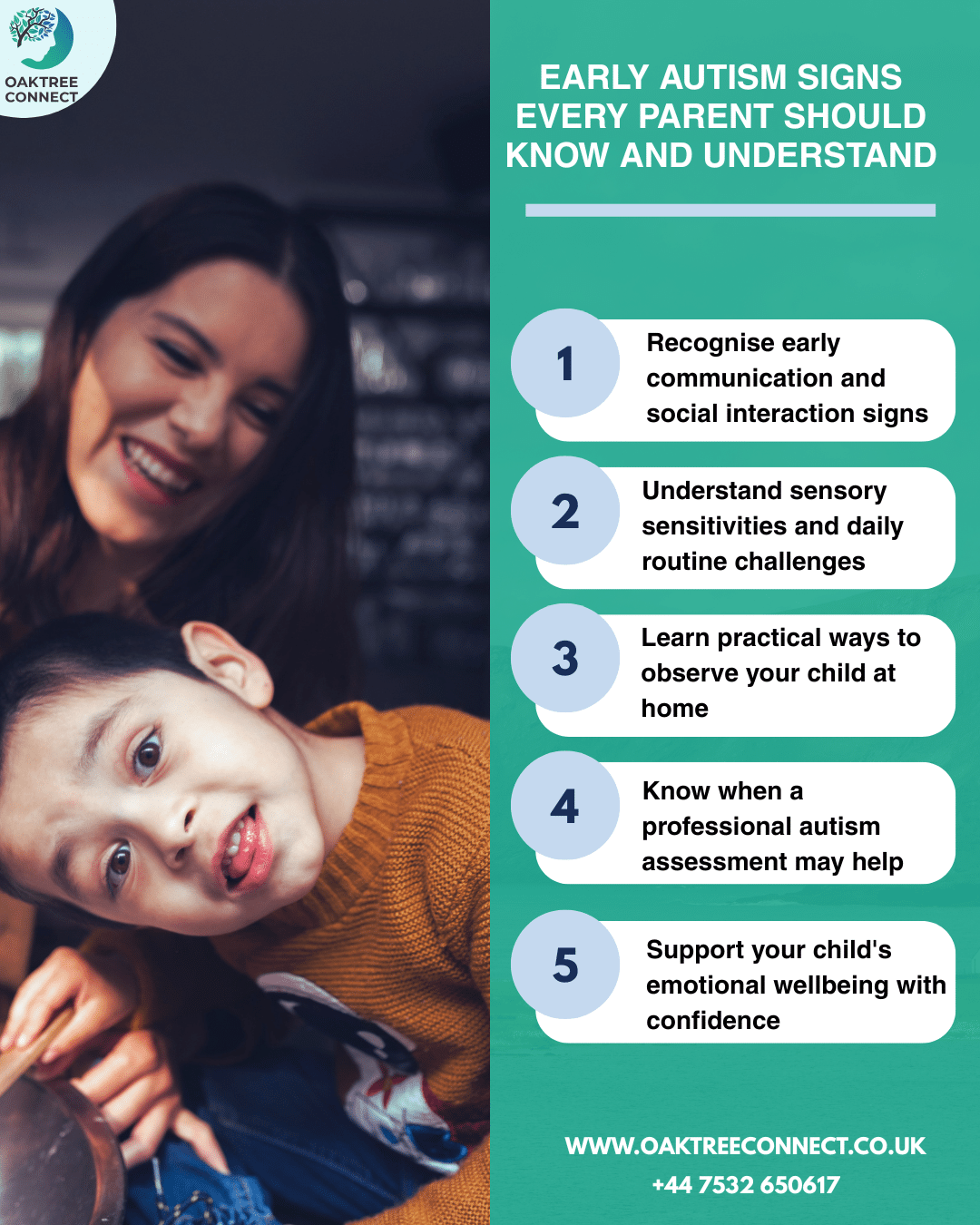
How to Understand Your Child at Home
One of the most important shifts parents can make is learning to read behaviour as communication. When a child has an emotional outburst that seems entirely out of proportion to what triggered it, the trigger is rarely the real issue. What you are usually seeing is the visible end point of overwhelm that has been accumulating, often invisibly, over hours or even days. Knowing this does not make the moment easier, but it does change how you respond, and that matters.
Withdrawal and apparent rudeness can reflect exhaustion or anxiety rather than indifference. Rigid refusal to try new things is often rooted in a genuine difficulty tolerating uncertainty rather than wilful defiance. When you approach your child’s behaviour with curiosity rather than frustration, you begin to see patterns that are genuinely informative.
Here is what I encourage parents to actively observe and record at home:
- Track patterns over time. Note whether the most difficult moments cluster around particular times of day, specific transitions like the end of school, or certain environments. One incident tells you very little. A pattern tells you a great deal.
- Identify what comes just before. What consistently precedes a meltdown or a period of complete shutdown? A change in plan? A sensory trigger? The end of screen time? Understanding the lead up is often more useful than analysing the outburst itself.
- Look for sensory triggers at home. Are there sounds, lighting levels, clothing materials, food textures or smells that reliably cause distress? Reducing unnecessary sensory load at home can make a significant difference to your child’s baseline stress levels.
- Watch how your child recovers. How long does it take for them to settle after a difficult episode? Do they need quiet and solitude, or proximity and reassurance? Understanding helps more than what we instinctively want to offer.
- Notice what makes the day go well. This is just as important as noting difficulties. Which environments, activities and social situations does your child manage comfortably? Where do they feel genuinely at ease? These observations reveal a great deal about what your child needs to thrive.
Simple changes at home can also make a real difference while you are waiting for clarity. Give advance warning before transitions rather than announcing them abruptly. Build predictability into the day with a consistent routine, even a loose one. Create a quiet space where your child can go to decompress without the pressure of conversation or performance. These are not solutions, but they reduce the daily friction that can make everything else harder.
Even informal notes on your phone over two or three weeks can be genuinely valuable when the time comes to speak to a clinician. They move the conversation away from broad descriptions and towards a much richer, more useful picture of your child’s daily experience.
When Should You Consider an Assessment?
Not every child who shows some of the features described here will go on to receive an autism diagnosis, and that is entirely fine. But if the difficulties you are noticing are having a real and meaningful impact on your child’s ability to learn, to form friendships, to manage their emotions, or simply to feel settled and secure in their daily life, then a formal assessment is worth pursuing.
NICE Guideline CG128, which governs the recognition, referral and diagnosis of autism in children and young people across the UK, recommends that a referral be considered when there are concerns across social communication, social interaction, or restricted and repetitive behaviours that are not better explained by another condition. Through the NHS, this process typically begins with your GP or your child’s school SENCO (Special Educational Needs Coordinator), either of whom can make a referral to a local autism diagnostic team.
NHS waiting times are unfortunately long in many parts of the country. If your child is struggling significantly at school, socially, or at home, and you feel that continuing to wait is causing real harm to their emotional wellbeing, a psychiatrist led private autism assessment in Birmingham may be a timely and worthwhile option.
How a Psychiatrist Led Assessment Can Help
At Oaktree Connect, autism assessments for children are led by a Consultant Child and Adolescent Psychiatrist with extensive experience across both NHS and independent practice. A psychiatrist led autism assessment is not a questionnaire or a simple checklist. It is a thorough evaluation of your child’s developmental history, their emotional and behavioural presentation, their individual strengths, and the specific difficulties they face in their day to day life.
Because autism rarely presents in isolation, our autism assessment in Birmingham also screens carefully for conditions that commonly occur alongside it, including ADHD, anxiety, sleep difficulties and low mood. These are extremely common in autistic young people and, if left unidentified, can significantly limit a child’s progress and quality of life.
The goal of a child psychiatrist assessment in Birmingham is not to arrive at a label for its own sake. It is to build a thorough and genuinely useful understanding of your child as an individual, one that leads to clear and practical recommendations for school, for home, and for any therapeutic support that might benefit them. We work closely with families at every stage of the process, and we aim to ensure that parents leave with real clarity about what they have learned and what to do next.
A Final Word
If you are reading this because you are worried about your child, please know that worry and curiosity are not the same as overreaction. Wanting to understand your child more fully is one of the most thoughtful and loving things a parent can do. You do not need to work through this uncertainty on your own, and the aim is never simply to find a label. It is to find the understanding that gives your child the best possible chance to flourish.
If you would like to explore an assessment or discuss your concerns with a qualified clinician, you can make an enquiry or book an appointment here: https://www.oaktreeconnect.co.uk/contact-us/
References and Further Reading
NHS Autism Guidance NHS guidance for parents on autism signs, diagnosis and support.
NICE Guideline CG128 Autism spectrum disorder in under 19s: recognition, referral and diagnosis.
National Autistic Society The UK’s leading charity for autistic people and their families.
Royal College of Psychiatrists: Autism Spectrum Disorder Information for parents and carers.
Disorder Related Blogs
- Anorexia Nervosa: Recognise the Quiet Killer
- Patient Talk – What Does Severe Clinical Depression Feel Like?
- Dear Mum: A Story by an Oaktree Patient with Depression
- SCHIZOPHRENIA – A Poem
- Autism: Dispelling Myths
- Mental Fitness: “I Have an Addiction”
Lifestyle Related Blogs
- Preventing Online Burnout
- Sad at Christmas? Help Is at Hand
- Burnout at Work
- Mental Fitness: How to Beat Stress
- Mental fitness: Brain Stimulation Therapy
- Mental Fitness: When Should You Stop Driving?
- Mental Fitness: “Let Us Talk About It”
- How to Combat Work-Related Stress
- Foods that make you happy
- Business Spending on Mental Health, Worth it?
- Employers Need More Awareness of Mental Health Issues
Other Blogs
- Christmas Wishes from Oaktree
- Using Narrative from Popular Cinema in therapy for Children & Young People
- ‘Trash Talk’ on the Pitch – Why Do They Do it?
- Prof Swaran Singh Talks on American News
- RTMS Training
- What happens during a TMS treatment?
Are you a leader and need mentoring or coaching? We may be able to help. Contact us at contact@oaktreeconnect.co.uk.
Facebook Linkedin Youtube Instagram
Author: Dr Meetu Singh
Dr Singh is the consultant psychiatrist with a special interest in neuropsychiatry. Having seen and treated hundreds of patients with ADHD, in London and Birmingham and with masters in Neuropsychiatry, she is well known as an expert in this field.
Contact:
Email – clinicadmin@oaktreeconnect.co.uk
Telephone – 020 39277699
Recent Blogs







Oaktree Connect Fees & Pricing for Other Services
There may be additional fees payable after your assessment, for which you will receive an invoice: for example, for the costs for prescribing medication agreed between you and the psychiatrist at the time of assessment. We try our utmost to stay within the time allocated for the appointment however, you could be charged for any extra time spent in the consultation, if the meeting runs over the allocated time, or where communications with you or reviewing notes etc. exceeds what is deemed reasonable, but this is at the discretion of the clinician.