
From Avoidance to Action: Recognising & Managing Social Anxiety

"Recovery from social anxiety is not about eliminating fear. It is about reclaiming the life fear has kept on hold."
— By Dr Meetu Singh
Have you ever found yourself standing outside a coffee shop, heart pounding, desperately replaying what you are going to say to the barista, only to turn around and walk away? Or perhaps spent hours after a casual dinner party dissecting, analysing, a single sentence you said, convinced that everyone at the table was secretly judging you.
If this sounds familiar, you are experiencing something much deeper than simple shyness. You might be dealing with Social Anxiety Disorder sometimes also referred to as ‘social phobia’, a highly common but widely misunderstood mental health condition.
Our connections with others shape who we are, driving our desire for community, friendship, and shared experiences. From navigating professional workplaces to enjoying casual dinners with friends, social interactions form the foundation of daily human life. Whilst many people experience occasional nervousness in some of these situations, some feel overwhelming fear or distress that significantly affects their ability to study, work, or maintain relationships.
In the UK, social anxiety affects people of all ages and backgrounds. Although no national UK survey has measured the disorder specifically in adults, international studies estimate that around 3-7% of adults experience social anxiety disorder in a given year, while as many as 12% may experience it at some point in their lives.
Unfortunately, many continue to struggle in silence, believing they are simply shy or lacking in confidence. In reality, social anxiety is a treatable condition, and early professional support can make a meaningful difference to long-term wellbeing.
This misunderstanding can lead to a long delay in treatment. NICE reports that only about half of affected adults ever seek help and that those who do commonly live with symptoms for 15 to 20 years first.
What Social Anxiety Actually Feels Like
Social anxiety is not just ‘being quiet’ or preferring a book to a crowded nightclub. It is an intense, persistent fear of being watched, judged, or scrutinised by others. For a person living with this condition, the world can feel like a perpetual stage where they are under a harsh spotlight, bound to make a humiliating mistake.
This condition is an inward-facing storm that combines intrusive thoughts with powerful physical sensations. These fears can arise in a wide range of situations, including speaking in front of colleagues, attending lectures, meeting unfamiliar people, eating in public, or even making telephone calls.
How Social Anxiety Differs from Introversion
It is vital to distinguish between a personality trait and a mental health disorder.
Feature | Introversion | Social Anxiety Disorder |
Core Nature | A healthy personality preference | A debilitating, fear-based mental illness |
Connection | Introverts choose solitude to recharge but can socialise comfortably | Sufferers deeply desire social connection but fear blocks them |
Impact | Enhances well-being when balanced | Limits career growth, education, and relationships |
Social anxiety disorder usually begins early: among adults seeking treatment, the median age of onset is in the early to mid-teens, and most developed symptoms before the age of 20.
Contributing factors may include genetics, temperament, previous experiences of bullying or criticism, stressful life events, or other underlying mental health conditions. It commonly occurs alongside depression, generalised anxiety disorder, panic disorder, or low self-esteem.
Around four in five adults with social anxiety disorder experience at least one other psychiatric condition during their lifetime. Studies cited by NICE have found overlap with other anxiety disorders in up to 70% of cases and with mood disorders in up to 65%.
The Vicious Cycle of Avoidance
Unlike ordinary nervousness, social anxiety can become so severe that individuals begin avoiding situations altogether. This avoidance may provide temporary relief, but over time it can reinforce anxiety and limit opportunities for education, employment, friendships, and personal development.
For university students, social anxiety may lead to avoiding seminars, group projects, presentations, or social events. In the workplace, employees may struggle to contribute during meetings, communicate with colleagues, interview for promotions, or build professional relationships. Socially, individuals may withdraw from family gatherings, friendships, or community activities, increasing feelings of isolation.
The consequences are not merely emotional. Research reviewed by NICE has associated generalised social anxiety disorder with wages around 10% lower than those of people without the condition. People with social anxiety also report more absence from work and lower productivity.
While escaping a social situation brings immediate relief, it creates a catch-22 situation. By avoiding the interaction, the brain is trained to think that the social situation is genuinely dangerous. Over time, the anxiety grows, invitations stop coming, and a cycle of deep isolation and loneliness takes hold.
Social anxiety does not always disappear with age. In one long-term study, participants had already lived with it for an average of 19 years; only 37% recovered during the following 12 years, a lower recovery rate than that recorded for generalised anxiety disorder or panic disorder.
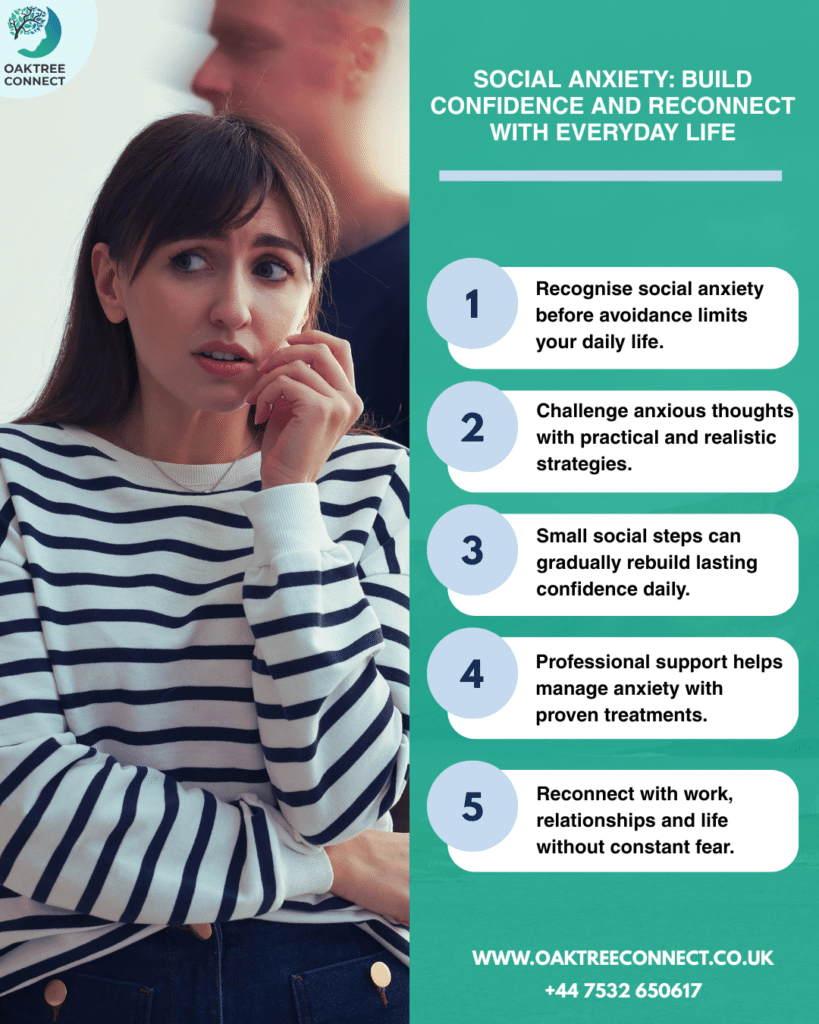
Signs That It May Be Time to Seek Professional Help
Many people delay seeking help because they assume their symptoms are simply part of their personality. However, persistent anxiety that interferes with daily functioning deserves professional assessment.
Common signs of social anxiety include:
- Intense fear before social or performance situations.
- Excessive worry about saying or doing something embarrassing.
- Avoiding meetings, presentations, interviews, or social gatherings.
- Physical symptoms such as blushing, trembling, sweating, nausea, or a racing heartbeat during social interactions.
- Difficulty making or maintaining friendships because of anxiety.
- Repeatedly analysing conversations afterwards and worrying about how others perceived you.
- Missing educational or career opportunities because of fear of social situations.
If these experiences are affecting your work performance, academic progress, relationships, or overall quality of life, it may be beneficial to seek mental health support from qualified professionals.
Early intervention can reduce the impact of symptoms and help individuals regain confidence in situations that previously felt overwhelming.
The Role of a Psychiatrist or Clinical Psychologist
Effective treatment begins with a thorough understanding of each individual’s experiences, symptoms, medical history, and personal circumstances.
A private psychiatrist can conduct a comprehensive psychiatric assessment to determine whether social anxiety disorder is present and identify any related mental health conditions. This assessment explores symptom patterns, severity, duration, and the impact on everyday functioning.
Following assessment, treatment recommendations are tailored to the individual’s needs. Depending on the severity of symptoms, these may include psychological therapy, medication, or a combination of both.
Clinical psychologists are highly trained in delivering evidence-based therapies for anxiety disorders. Cognitive Behavioural Therapy (CBT) is widely recognised as an effective treatment for social anxiety and helps individuals identify unhelpful thinking patterns, gradually face feared situations, and develop practical coping strategies. Other therapeutic approaches may also be recommended depending on the person’s clinical presentation.
Consultant psychiatrists play an important role when symptoms are severe, persistent, or accompanied by other mental health conditions. They can advise whether medication may be appropriate, carefully monitor treatment, and adjust medication where necessary to support recovery. Medication decisions are always made collaboratively, taking into account the individual’s preferences, medical history, and overall health.
Many people also appreciate the convenience of an online psychiatrist consultation, allowing them to access specialist care from home while maintaining privacy and flexibility.
Actionable Strategies to Reclaim Your Peace
If social anxiety is dictating your choices, you do not have to live at the mercy of your fear. If managed in good time and appropriately, anxiety can eventually become a temporary discomfort managed with compassion rather than a force that rules your life.
Here are proven strategies to begin moving forward:
- Gently Challenge Your Thoughts: When your mind tells you, “Everyone thinks I’m strange,” pause. Ask yourself if you have objective evidence for that claim, or if it is just the anxiety talking.
- Practice Micro-Exposures: Do not start with a huge party. Instead, use systematic exposure therapy. Try walking to a cafe alone, making eye contact with a cashier, or asking a stranger for the time. Let your brain learn that nothing catastrophic happens.
- Shift Your Focus Outward: Social anxiety makes you highly self-conscious. Actively force your attention away from your internal sensations and focus intentionally on the details of your environment, such as the music playing, the colour of the walls, or the exact words the other person is saying.
- Adjust Your Daily Habits: Reduce caffeine, which mimics physical panic symptoms, and prioritise consistent sleep. Regular exercise, adequate sleep and mindfulness may support general wellbeing and help some people manage anxiety, although they are not substitutes for recommended psychological or medical treatment.
When to Seek Professional Support
Self-help strategies are excellent, but you do not have to fight this alone. If your anxiety prevents you from going to work, finishing school, or forming meaningful bonds, or you experience physical panic symptoms, reaching out to a professional is a vital next step.
Evidence-based clinical treatments include individual Cognitive Behavioural Therapy (CBT) to reframe negative thought cycles, group therapy to practice skills safely, and medical treatments like SSRIs or beta-blockers to regulate physical symptoms, if preferred.
For more severe symptoms which mean that leaving home becomes difficult, the prospect of talking to colleagues at work brings about panic then you may consider seeing a psychiatrist (medical doctor) for assessment and diagnosis.
If you are currently supporting a friend or loved one who is struggling, simple gestures matter. Try sending a low-pressure text to check in or directly asking them what specific support they need to feel comfortable.
Living with social anxiety can be exhausting and even disabling, affecting education, employment, relationships, and everyday activities. However, effective assessment and treatment are available, and many people experience significant improvement with appropriate professional care.
If anxiety about social situations is preventing you from living the life you want, seeking support is an important first step. A comprehensive assessment by an experienced psychiatrist or clinical psychologist can help identify the underlying causes of your symptoms and guide you towards evidence-based treatment that is appropriate for your individual needs.
At Oaktree Connect, experienced consultant psychiatrists and clinical psychologists provide personalised psychiatric assessments, therapy, medication management where appropriate, and ongoing support to help patients across the UK move towards improved mental health and wellbeing.
Informational Notice
This article is provided for general informational purposes only and should not be considered a substitute for personalised medical advice, diagnosis, or treatment. If you are concerned about your mental health or believe you may be experiencing social anxiety disorder, please seek advice from a qualified healthcare professional. If you require urgent assistance or are experiencing a mental health emergency, contact NHS 111, your local emergency services, or attend your nearest Accident and Emergency department.
References
Bruce, S.E., Yonkers, K.A., Otto, M.W., Eisen, J.L., Weisberg, R.B., Pagano, M., Shea, M.T. and Keller, M.B. (2005) ‘Influence of psychiatric comorbidity on recovery and recurrence in generalized anxiety disorder, social phobia, and panic disorder: a 12-year prospective study’, American Journal of Psychiatry, 162(6), pp. 1179–1187. Available at: https://pubmed.ncbi.nlm.nih.gov/15930067/
Katzelnick, D.J., Kobak, K.A., DeLeire, T., Henk, H.J., Greist, J.H., Davidson, J.R.T., Schneier, F.R., Stein, M.B. and Helstad, C.P. (2001) ‘Impact of generalized social anxiety disorder in managed care’, American Journal of Psychiatry, 158(12), pp. 1999–2007. Available at: https://doi.org/10.1176/appi.ajp.158.12.1999
Kessler, R.C., Berglund, P., Demler, O., Jin, R., Merikangas, K.R. and Walters, E.E. (2005) ‘Lifetime prevalence and age-of-onset distributions of DSM-IV disorders in the National Comorbidity Survey Replication’, Archives of General Psychiatry, 62(6), pp. 593–602. Available at: https://doi.org/10.1001/archpsyc.62.6.593
National Collaborating Centre for Mental Health (2013) Social Anxiety Disorder: Recognition, Assessment and Treatment. NICE Clinical Guideline No. 159. Leicester: British Psychological Society and Royal College of Psychiatrists. Available at: https://www.ncbi.nlm.nih.gov/books/NBK327674/
National Health Service (NHS) (n.d.) ‘Social anxiety (social phobia)’. Available at: https://www.nhs.uk/mental-health/conditions/social-anxiety/ (Accessed: 22 July 2026).
NHS England (2024) NHS Talking Therapies for Anxiety and Depression Manual, version 7.1. Available at: https://www.england.nhs.uk/wp-content/uploads/2018/06/nhs-talking-therapies-manual-v7.1-updated.pdf
NHS England (2025) Adult Psychiatric Morbidity Survey: Survey of Mental Health and Wellbeing, England, 2023/24. Available at: https://digital.nhs.uk/data-and-information/publications/statistical/adult-psychiatric-morbidity-survey/survey-of-mental-health-and-wellbeing-england-2023-24
National Institute for Health and Care Excellence (NICE) (2013) Social anxiety disorder: recognition, assessment and treatment. Clinical guideline CG159. Available at: https://www.nice.org.uk/guidance/cg159
National Institute for Health and Care Excellence (NICE) (2013) ‘Recommendations: social anxiety disorder—recognition, assessment and treatment’. Available at: https://www.nice.org.uk/guidance/cg159/chapter/recommendations
Ruscio, A.M., Brown, T.A., Chiu, W.T., Sareen, J., Stein, M.B. and Kessler, R.C. (2008) ‘Social fears and social phobia in the USA: results from the National Comorbidity Survey Replication’, Psychological Medicine, 38(1), pp. 15–28.
Disorder Related Blogs
- Anorexia Nervosa: Recognise the Quiet Killer
- Patient Talk - What Does Severe Clinical Depression Feel Like?
- Dear Mum: A Story by an Oaktree Patient with Depression
- SCHIZOPHRENIA – A Poem
- Autism: Dispelling Myths
- Mental Fitness: “I Have an Addiction”
Lifestyle Related Blogs
- Preventing Online Burnout
- Sad at Christmas? Help Is at Hand
- Burnout at Work
- Mental Fitness: How to Beat Stress
- Mental fitness: Brain Stimulation Therapy
- Mental Fitness: When Should You Stop Driving?
- Mental Fitness: “Let Us Talk About It”
- How to Combat Work-Related Stress
- Foods that make you happy
- Business Spending on Mental Health, Worth it?
- Employers Need More Awareness of Mental Health Issues
Other Blogs
Are you a leader and need mentoring or coaching? We may be able to help. Contact us at contact@oaktreeconnect.co.uk.

Author: Dr Meetu Singh
Dr Singh is the consultant psychiatrist with a special interest in neuropsychiatry. Having seen and treated hundreds of patients with ADHD, in London and Birmingham and with masters in Neuropsychiatry, she is well known as an expert in this field.
Contact:
Email – clinicadmin@oaktreeconnect.co.uk
Telephone – 020 39277699
Recent Blogs







Oaktree Connect Fees & Pricing for Other Services
There may be additional fees payable after your assessment, for which you will receive an invoice: for example, for the costs for prescribing medication agreed between you and the psychiatrist at the time of assessment. We try our utmost to stay within the time allocated for the appointment however, you could be charged for any extra time spent in the consultation, if the meeting runs over the allocated time, or where communications with you or reviewing notes etc. exceeds what is deemed reasonable, but this is at the discretion of the clinician.