
What do you do when you have nothing to do?

"Normally, when we find ourselves at a loose end, we reach for our phones."
— By Divya Guha
Often, when we find ourselves at a loose end, we reach for our phones. We visit a café, and use it to photograph it and post online or on the family WhatsApp group. We track our personal growth on smart watches; we don’t simply walk, we must do our steps, productivity apps tell us how much time we made; we answer emails outside working hours; turn hobbies into side hustles; give us one empty afternoon and we have a task list. And, increasingly, we make travel into a performance, too: we make memories.
The world gets under our skins. What do you do when you have nothing to do? is therefore a surprisingly difficult question. Holidays are the socially sanctioned period in which to be idle, but some of us are better at taking time off and rather less good at really switching off.
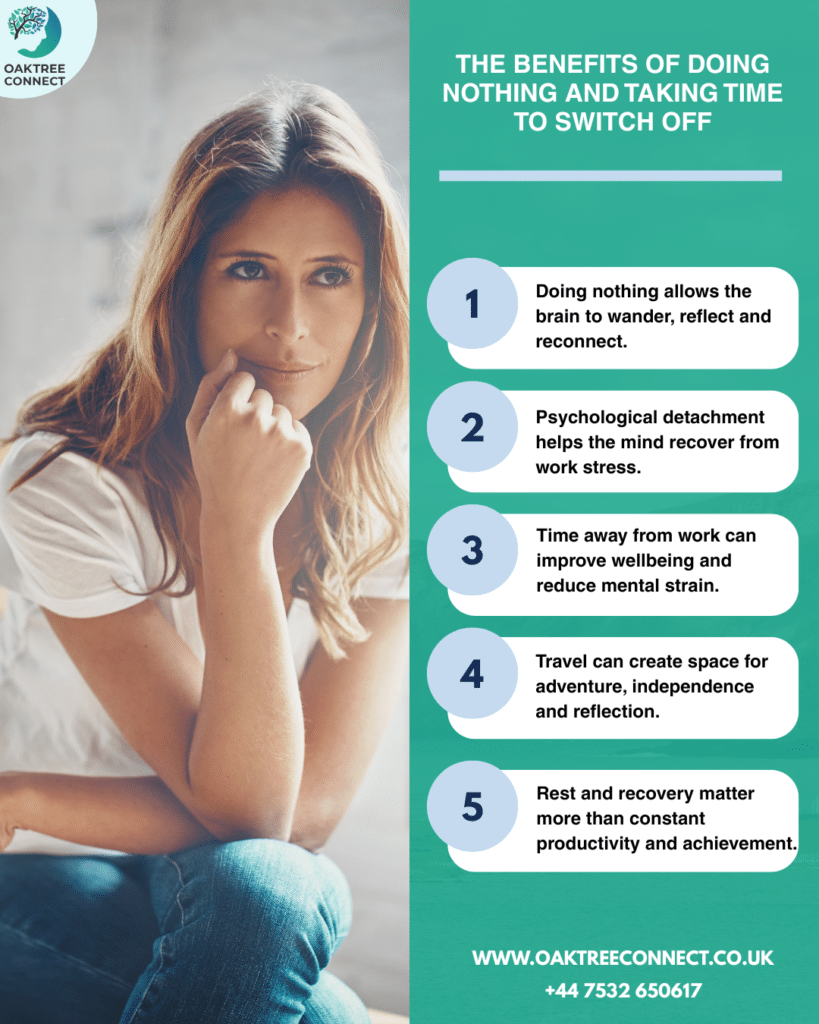
What we do when we do nothing
When we stop concentrating on external tasks, the brain does not switch off but enters different patterns of activity associated with internally directed thought, autobiographical memory and mind-wandering. We may begin remembering things, making connections, imagining possibilities or simply noticing what is going on inside of us.
This is what the culture of being externally productive diminishes within us. The argument is not that work is bad. It can provide meaning, identity, structure, social contact and financial security; for many people, it may be an important part of how we understand ourselves.
Rachel Wiseman writing for The Point in “Switching Off: Joseph Brodsky and the Moral Responsibility to Be Useless,” recounts the case of the poet who was prosecuted by the Soviet state for ‘social parasitism’ because his work did not fit the definition of productive employment. He said he was thinking about stuff, and writing. But the authorities believed that either you were building the state by being productive, or ‘screwing it up.’ The moral responsibility to be useless is a jarring phrase because while, nowadays, we won’t go to jail for slacking, but we can be made to feel faintly immoral nonetheless.
The counterculture of the 1960s, too, challenged the equation of work, consumption and productivity with a meaningful life. Communal living, wandering, meditation, psychedelics, idleness and infamously ‘dropping out’ were attempts to imagine another life. I do not endorse dropping out, but what if life did not have to be organised around economic usefulness? Even contemporary neuroscience and occupational psychology are pondering that old free-spirited idyll. A 2009 study by Jessica de Bloom and colleagues found that taking time off had a measurable positive effect on health and wellbeing, although much of the benefit faded after people returned to work.
We know the feeling. A holiday makes us feel better for a bit but cannot indefinitely compensate for a life organised around exhaustion.
Another 2018 controlled trial involving 40 middle managers, 67.5% men and 32.5% women. Twenty spent four nights in a hotel outside their normal environment and twenty stayed at home. Both groups improved, but the hotel group experienced a greater reduction in strain suggesting that changing environment may confer some additional benefit.
Our nervous system requires recovery but a houseboat in Kerala is not restorative if you are responding to Slack, or thinking of Monday in a Tuscany vineyard, either.
Sonnentag and Fritz’s 2015 stressor-detachment model is useful here. Their review found that psychological detachment means mentally disengaging from work during non-work time, and that poor detachment is associated with greater strain and poorer wellbeing.
The evidence was developed further in a 2025 analysis by Grant, Buchanan and Shockley which examined 32 studies containing 256 effect sizes. Unlike the 2009 meta-analysis, it found a large positive effect of vacation on employee wellbeing, and the benefits did not fade as quickly as the earlier research suggested. They also analysed eight studies comprising 69 effect sizes concerning activities and recovery experiences during vacation. Psychological detachment and physical activity emerged as particularly beneficial.
Safety and adventure
Many of us think of travel as tourism. For introverts, travel is a burden; for others, it may be stimulating. Even the means of travel can change experience. A cruise, a bicycle, a car, a bus and a train offer different degrees of solitude, community and speed. Flying transports us while eliminating the experience of the landscape; the train allows us to watch a country unfold, while a bus may put us close enough to strangers to become part of their ordinary journeys.
Christopher Nolan’s adaptation of Homer’s Odyssey the Ithacan hero is travelling because he wants to get home, while the journey becomes the extraordinary experience through which he is transformed and tested.
The Beatles’ Magical Mystery Tour was conceived as a bus journey whose destination was deliberately part of the mystery, and the band’s own account describes it as having a vague outline that was filled in as they went. It makes a similar promise of structured uncertainty: come along, and we will see where we go.
The road trip has its own mythology in which the destination becomes less important than what happens along the way and has always contained an element of dream because it allows us to move through geographical space, but also memory and imagination.
The temporary freedom of cognitive motion interrupts our familiar mental maps: a language spoken in a different register, customs which may be incomprehensible, or when the itinerary fails, being forced to deal with unexpected change.
Travel brings forth agency and vulnerability. Solo travellers can unexpectedly become part of a temporary community on a train, in a hostel or café. Encountering people or cultures unlike our own can be a valuable disruption, reminding us that our way of doing things is, but, one way of living.
We do not necessarily grow out of it. A child moves away from a parent to explore; later, the adolescent ventures further, until eventually the adult may leave altogether. The traditional gap year can be understood as a culturally sanctioned version of this movement: a young person travelling independently, taking buses because they are on a budget, staying in hostels, meeting other travellers and discovering that strangers sometimes help when they are needed. It is an experience that develops agency.
This can become particularly meaningful as we grow older and realise that the people who once made the world feel safe will not always be there. Travel can then become more than tourism or escape; it can be a rehearsal for independence, separation and individuation.
Travel gives that part of us a little more room to move.
Disorder Related Blogs
- Anorexia Nervosa: Recognise the Quiet Killer
- Patient Talk - What Does Severe Clinical Depression Feel Like?
- Dear Mum: A Story by an Oaktree Patient with Depression
- SCHIZOPHRENIA – A Poem
- Autism: Dispelling Myths
- Mental Fitness: “I Have an Addiction”
Lifestyle Related Blogs
- Preventing Online Burnout
- Sad at Christmas? Help Is at Hand
- Burnout at Work
- Mental Fitness: How to Beat Stress
- Mental fitness: Brain Stimulation Therapy
- Mental Fitness: When Should You Stop Driving?
- Mental Fitness: “Let Us Talk About It”
- How to Combat Work-Related Stress
- Foods that make you happy
- Business Spending on Mental Health, Worth it?
- Employers Need More Awareness of Mental Health Issues
Other Blogs
Are you a leader and need mentoring or coaching? We may be able to help. Contact us at contact@oaktreeconnect.co.uk.

Author: Divya Guha
Divya is a journalist and editor with over two decades’ experience writing on diverse topics including mental health, grief and contemporary social issues drawing on academic research and expert perspectives. Her work is research-driven and aims to make complex ideas accessible. She holds an MA in Journalism from Goldsmiths College, London.
Contact:
Email – clinicadmin@oaktreeconnect.co.uk
Telephone – 020 39277699
Recent Blogs







Oaktree Connect Fees & Pricing for Other Services
There may be additional fees payable after your assessment, for which you will receive an invoice: for example, for the costs for prescribing medication agreed between you and the psychiatrist at the time of assessment. We try our utmost to stay within the time allocated for the appointment however, you could be charged for any extra time spent in the consultation, if the meeting runs over the allocated time, or where communications with you or reviewing notes etc. exceeds what is deemed reasonable, but this is at the discretion of the clinician.