
Coping with Bipolar Disorder in Everyday UK Life
By Oaktree Connect | April 2026
Facebook Linkedin Youtube Instagram
“Bipolar disorder is not defined by mood alone, but by patterns over time — and with accurate diagnosis and doctor-led care, stability becomes achievable.”
— Oaktree Connect
In clinical practice, not uncommonly the clinicians meet people who describe feeling unusually energised with little need for sleep, racing thoughts and feeling overly confident in all situations only to later experience periods of low mood, constant fatigue, lack of enthusiasm or interest in doing anything with withdrawal from daily life or social contact. These patterns can start to occur from late teens to the mid-twenties and are recognised, in hindsight, as part of bipolar disorder. The symptoms of bipolar disorder can vary in intensity and duration throughout life as well as in different individuals.
In the UK, bipolar disorder is estimated to affect around 1–2% of the whole population, but the number of people diagnosed are much lower as many people may remain undiagnosed for many years.
Its impact extends beyond symptoms alone, often influencing abilities, relationships, everyday responsibilities, physical health and finances. Understanding how bipolar disorder presents in real life is an important initial step towards managing it effectively and reducing disruption to day to day functioning.
Understanding Bipolar Disorder
Bipolar disorder is a mental disorder defined and classified in the established diagnostic texts including International Code of Diseases (ICD-11) and Diagnostic and Diagnostic and Statistical Manual of Mental Disorders (DSM-5-TR) as a mood disorder involving distinct episodes of mood disturbance.
These episodes are not simply brief mood changes but distinct and sustained periods of weeks or months of highs or lows that affect the sufferer’s thinking, behaviour and physical wellbeing. It is also important to recognise that bipolar disorder is often a long term condition with a variable course. Some individuals experience infrequent episodes, while others may suffer frequent recurrent difficulties. Over time, patterns often become clearer, which can help guide more effective management and relapse prevention planning.
Core Features
Manic or hypomanic episodes involve a noticeable change from a person’s usual state. Individuals may feel unusually confident or irritable, need less sleep, speak more quickly, and take on activities impulsively. In more severe cases, judgement can be impaired. Depressive episodes are characterised by persistent low mood, reduced interest in usual activities, low energy, and difficulties with concentration or sleep. Some individuals describe a sense of emotional heaviness or disconnection that affects even simple daily tasks. Between episodes, many people experience periods of relative stability, although the duration and frequency of episodes can vary.
Types of Bipolar Disorder
Bipolar I disorder involves at least one episode of full mania which is different from hypo-mania by intensity and disability caused by the episode, often alongside depressive episodes. Bipolar II disorder involves recurrent depressive episodes with less severe hypomania but still clinically significant. This distinction has to be assessed by an experienced and highly skilled practitioner such as a psychiatrist as the treatment plans rely on it, to some extent.
Common Misconceptions
Bipolar disorder is often misunderstood as rapid or minor mood swings and can be confused with emotionally unstable personality disorder or mood variations experienced by people with a diagnosis of attention deficit hyperactivity disorder (ADHD). In clinical terms, episodes are more sustained and can significantly affect functioning. An expert conducting the assessment for diagnosis so that appropriate and customised treatment plan is developed.
Another myth worth mentioning here is the assumption that people once diagnosed with bipolar affective disorder (BPAD) cannot maintain employment or relationships. To the contrary, many successful professionals and those happy in their homelife with long term relationships have been diagnosed with this disorder and with appropriate support, live stable and productive lives.
How It Affects Everyday Life
The effects of bipolar disorder are often most evident in everyday situations rather than in isolated symptoms. In practice, the impact of bipolar disorder is rarely limited to symptoms alone. It often becomes most apparent in the way day to day life is experienced and managed over time.
Work and Education
During depressive phases, with complete lack of motivation or interest and given the cognitive effects the individual may find it difficult to concentrate or get tasks done, maintaining regular attendance may become challenging.
In contrast, during periods of elevated mood, there may be increased productivity initially, but they may jump from task to task without completing any, with work becoming difficult to sustain. Behaviour at home and work may become erratic and uncharacteristic. They are more likely to over-commit or display of errors in judgement.
Relationships
Changes in mood and energy can affect communication and consistency. Family members or colleagues may find it difficult to understand shifts in behaviour, particularly if these changes occur over a relatively short period. This can lead to strain if not recognised and discussed openly.
Daily Functioning
Sleep patterns are often disrupted, which in itself can influence mood stability negatively. Financial decisions, daily routines, and self care may also be affected during different phases of the condition. These impacts are often cumulative and can become more noticeable over time without appropriate support.
Importance of Accurate Assessment or Identification
A careful and structured assessment is central to understanding whether symptoms are consistent with bipolar disorder. It can be frustrating for individuals when symptoms are not recognised early, particularly if they have been present for some time or have been understood in different ways previously. A clear and careful assessment can often bring a sense of clarity to experiences that may have felt confusing or inconsistent.
Why Assessment Matters
Bipolar disorder can sometimes be misidentified as depression alone, particularly if an individual seeks help during a low mood phase. This can lead to treatment approaches that do not fully address the condition. Early and accurate identification helps reduce the risk of relapse, supports appropriate treatment planning, and provides individuals with a clearer understanding of their experiences. A comprehensive mental health assessment UK typically includes a detailed clinical history, exploration of mood patterns over time, and consideration of personal and family factors. Consultant psychiatrists are trained to assess diagnostic complexity and medical aspects of care, while HCPC registered clinical psychologists contribute to understanding psychological patterns and developing a formulation that guides treatment.
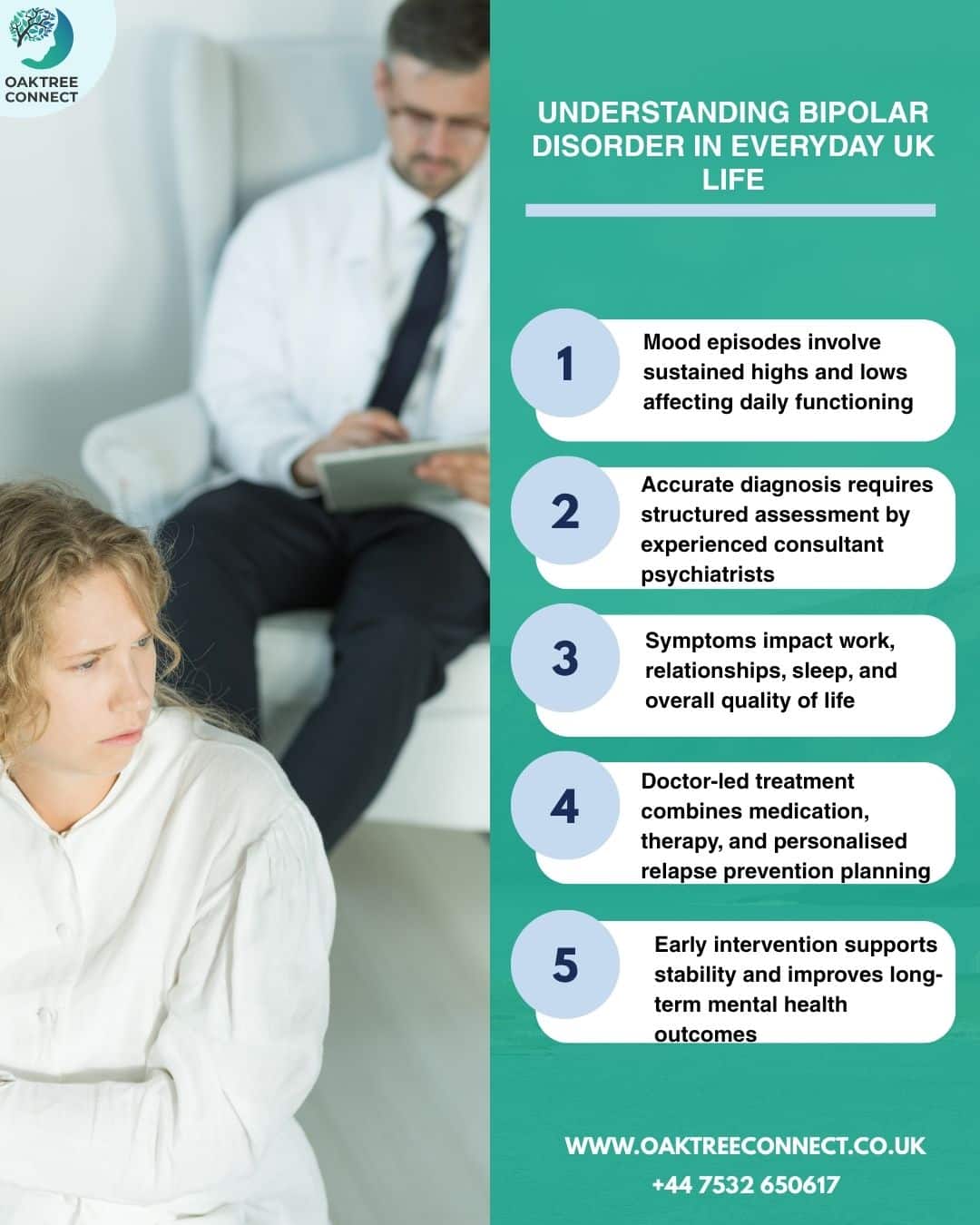
Doctor Led Assessment at Oaktree Connect
At Oaktree Connect, assessments are conducted by experienced consultant psychiatrists and clinical psychologists with backgrounds in NHS and independent practice. The approach reflects a structured and multidisciplinary model of care. This typically includes a detailed psychiatric evaluation, exploration of current concerns and past history, and a psychological formulation that considers contributing factors. Where appropriate, medication options are reviewed in a measured and collaborative way. The aim is to provide a clear understanding of the individual’s presentation rather than focusing solely on diagnosis. Services are delivered online across the UK, allowing access to specialist support without geographical limitations. In practice, the emphasis is not only on identifying whether diagnostic criteria are met, but also on understanding how symptoms have developed over time and how they are currently affecting everyday functioning.
Further information about when a psychiatric assessment may be helpful can be found here
Treatment and Management Options
Management of bipolar disorder usually involves a combination of medical and psychological approaches, tailored to the individual’s needs. An important part of longer term care is relapse prevention planning. This often involves identifying early warning signs of mood change, agreeing on steps to take if these arise, and ensuring appropriate follow up support is in place.
Medical Approaches
Medication such as mood stabilisers or antipsychotic treatments may be recommended to help reduce the frequency and severity of mood episodes. These treatments are typically monitored regularly to ensure effectiveness and minimise side effects.
Psychological Therapies
Psychological interventions such as cognitive behavioural therapy can help individuals recognise patterns in mood and behaviour and develop strategies to manage early warning signs. Psychoeducation is an important component, supporting individuals to understand their condition and engage actively in their care. In some cases, trauma informed approaches may also be relevant.
Other Interventions
Attention to sleep patterns and daily structure is often emphasised, as disruption to routine can influence mood stability. In selected cases, additional treatments such as neuromodulation may be considered as part of specialist care. Treatment is most effective when it is individualised and reviewed over time, rather than based on a single approach.
Living with Bipolar Disorder
In practice, many people find that living with bipolar disorder involves gradually developing a consistent and informed approach to managing day to day life. Establishing regular routines, particularly around sleep and daily activities, can support stability. Monitoring changes in mood or energy levels can help identify early signs of a shift in mood, allowing for timely adjustment of support or treatment. Support from family, friends, and professionals is often helpful, particularly when those around the individual have an understanding of the condition. Managing stress in a balanced way is also important. This does not mean avoiding all demands, but recognising limits and maintaining a sustainable pace of activity. Over time, individuals often become more familiar with their own patterns, which can support earlier recognition of changes and more timely support.
Accessing Support in the UK
In the UK, support for bipolar disorder can be accessed through NHS services or private providers. NHS care is usually accessed via a GP referral to community mental health teams or specialist services, although waiting times may vary. Private services provide access to a private psychiatrist UK or private psychologist UK, often with greater flexibility in appointment timing. A comprehensive mental health assessment UK can be arranged directly, alongside ongoing support such as online therapy UK. Oaktree Connect offers UK wide online services, including psychiatric assessment, psychological therapy, and structured care pathways with transparent pricing. Where there are overlapping or additional concerns, services such as ADHD assessment UK or autism assessment UK may also be considered, guided by the individual’s clinical presentation.
Safety and Crisis Guidance
Oaktree Connect is not an emergency service. If you are in crisis, contact NHS 111 or emergency services. If there is an immediate risk to safety, urgent support through NHS services is essential.
Conclusion (Clinical Closing)
Bipolar disorder can affect many areas of everyday life, but it is a condition that can be managed with appropriate understanding and care. A careful assessment, followed by a considered and individualised treatment plan, can support stability over time. Seeking professional input at an early stage can help clarify symptoms and guide effective support.
Summary
Bipolar disorder involves periods of elevated mood and depression that can affect everyday functioning. A structured mental health assessment UK is important for accurate diagnosis and appropriate treatment planning. Management typically includes a combination of medication and psychological therapies tailored to individual needs. Recognising early changes in mood and maintaining a consistent routine can support longer term stability.
If you would like to explore an assessment or discuss your concerns with a qualified clinician, you can make an enquiry or book an appointment here: https://www.oaktreeconnect.co.uk/contact-us/
Disorder Related Blogs
- Anorexia Nervosa: Recognise the Quiet Killer
- Patient Talk – What Does Severe Clinical Depression Feel Like?
- Dear Mum: A Story by an Oaktree Patient with Depression
- SCHIZOPHRENIA – A Poem
- Autism: Dispelling Myths
- Mental Fitness: “I Have an Addiction”
Lifestyle Related Blogs
- Preventing Online Burnout
- Sad at Christmas? Help Is at Hand
- Burnout at Work
- Mental Fitness: How to Beat Stress
- Mental fitness: Brain Stimulation Therapy
- Mental Fitness: When Should You Stop Driving?
- Mental Fitness: “Let Us Talk About It”
- How to Combat Work-Related Stress
- Foods that make you happy
- Business Spending on Mental Health, Worth it?
- Employers Need More Awareness of Mental Health Issues
Other Blogs
- Christmas Wishes from Oaktree
- Using Narrative from Popular Cinema in therapy for Children & Young People
- ‘Trash Talk’ on the Pitch – Why Do They Do it?
- Prof Swaran Singh Talks on American News
- RTMS Training
- What happens during a TMS treatment?
Are you a leader and need mentoring or coaching? We may be able to help. Contact us at contact@oaktreeconnect.co.uk.
Facebook Linkedin Youtube Instagram
Author: Dr Meetu Singh
Dr Singh is the consultant psychiatrist with a special interest in neuropsychiatry. Having seen and treated hundreds of patients with ADHD, in London and Birmingham and with masters in Neuropsychiatry, she is well known as an expert in this field.
Contact:
Email – clinicadmin@oaktreeconnect.co.uk
Telephone – 020 39277699
Recent Blogs







Oaktree Connect Fees & Pricing for Other Services
There may be additional fees payable after your assessment, for which you will receive an invoice: for example, for the costs for prescribing medication agreed between you and the psychiatrist at the time of assessment. We try our utmost to stay within the time allocated for the appointment however, you could be charged for any extra time spent in the consultation, if the meeting runs over the allocated time, or where communications with you or reviewing notes etc. exceeds what is deemed reasonable, but this is at the discretion of the clinician.