
How do we learn to live in a world that no longer contains someone who shaped it?

"Recovery from social anxiety is not about eliminating fear. It is about reclaiming the life fear has kept on hold."
— By Dr Meetu Singh
We know death in the abstract, we understand it intellectually as we watch parents get older, hear about sudden accidents, and see relatives ageing. Yet when death arrives at our door, it rarely feels like something we were expecting. Instead, it can feel as though all the laws governing the world had changed, and with extraordinary violence. It might come after long periods of anticipatory mourning, when a loved one has been slowly disappearing through illness, or cancer. Even then, the moment of death has an unexpected finality: years preparing can still bring disbelief.
It may revisit our opening a wardrobe that still contains a particular scent, hearing the door because your body still clocks them in at certain times. Increasingly, it is social media reminders, or old texts. Yet each encounter carries the same tiny shock followed by a despairing reality check.
Many people think grief is something between sadness and depression but clinicians have come to understand that it is much larger than losing someone we love.
Relearning the world
More than a century ago, Sigmund Freud writing in Mourning and Melancholia (1917), suggested that the mind slowly and painfully reorganises itself around an absence — that mourning demanded an enormous amount of psychological work. While this insight has proved durable, the language of psychology has become much more nuanced.
Neurologist and writer Oliver Sacks observed that much of our nervous system develops around the people closest to us, and that after such an injury we are forced to remap our world. We gradually realise that this internal map is far more detailed than we had imagined, containing countless tiny landmarks that organised our days. A partner sleeps on one side of the bed, answers the telephone at a particular time, or walks through the front door at six o’clock. These expectations become so deeply embedded that we rarely notice them until they are no longer true.
This may help explain why clinicians sometimes compare bereavement to a phantom limb. After an amputation, the missing limb can still feel present because the brain’s map of the body has not yet caught up with reality.
In The Grieving Brain (2022), Mary-Frances O’Connor argues that our brains are constantly making predictions about the people we love. Shaped by years of shared life, this predictive system continues to expect their return. Bereaved people may smell a familiar perfume, hear footsteps on the stairs, or wake in the night expecting someone to be beside them before remembering they are gone. These moments can be deeply unsettling, yet they speak to the extraordinary intimacy of human attachment. They are not signs of mental illness, but part of the bewildering task of relearning the world after someone has gone.
When someone close to us dies, we lose far more than companionship. We lose someone whose presence helped regulate our nervous system. Grief is therefore not simply emotional; it is profoundly physiological.
No man an island
Attachment theory begins with a simple observation: human beings are not designed to navigate the world alone. Developed by the British psychiatrist and psychoanalyst John Bowlby in the 1950s and ‘60s, attachment theory proposes that our earliest relationships with caregivers shape how we seek comfort, safety and connection throughout life. As infants, we rely on parents or caregivers not only for food and shelter but also to regulate our emotions and physiology. Over time, these attachment figures become a ‘secure base’ or safe haven from which we explore the world and to which we return in times of stress.
Contemporary neuroscience has deepened this understanding by showing that close relationships become biologically embedded in our nervous system. Long-term partners, family members and close friends help regulate our heart rate, cortisol levels, stress responses and even sleep. Studies have shown, for example, that simply holding the hand of a trusted partner can reduce activity in brain regions associated with threat and pain, while seeing the face of a loved one can dampen the body’s physiological stress response (Coan, Schaefer and Davidson, 2006). In other words, the people closest to us become part of the body’s regulatory system. When they die, we lose far more than companionship. We lose someone whose presence helped our brain and body feel safe. This is one reason why grief is not simply an emotional experience but a profoundly physical one, requiring the nervous system to adapt to a world in which one of its most important sources of regulation is suddenly absent.
Decades of research have expanded on that insight, showing that trusted relationships help regulate heart rate, stress hormones, sleep and emotional responses. Couples’ physiological states often become synchronised over years of living together, and laboratory studies suggest that simply holding the hand of someone we trust can reduce neural responses to threat.
This helps explain the long-recognised ‘widowhood effect.’ Colin Murray Parkes found mortality among recently bereaved widowers was about 40 percent higher during the first six months after a wife’s death than among married men of the same age. Insurance companies in the 1950s and ‘60s knew bereavement’s correlation with increased illness and premature death, particularly heart disease, during the first year after loss. The phrase ‘dying of a broken heart’ turns out to be more than metaphor.
Everyone grieves differently
One of the most important developments in bereavement research over the past two decades has been recognising that grief itself is not a mental illness, but that, for a small minority of people, it can become so persistent and disabling that it requires clinical treatment. This distinction lies at the heart of Prolonged Grief Disorder (PGD), which is now recognised in the Diagnostic and Statistical Manual of Mental Disorders (DSM-V).
The difference between normal grief and PGD is not simply a matter of how long someone grieves, but whether they are gradually able to adapt to a world without the person they have lost. In normal bereavement, grief often comes in waves. One moment, a bereaved parent may be overwhelmed by tears after hearing their child’s favourite song; the next, they may find themselves laughing with a friend over coffee. This oscillation between confronting the loss and engaging with everyday life is considered a healthy part of mourning and forms the basis of Margaret Stroebe and Henk Schut’s influential 1999 Dual Process Model. Although the pain may never disappear entirely, most people slowly begin to rebuild routines, relationships and a sense of meaning.
In PGD that adaptation becomes stalled. Intense yearning for the deceased, difficulty accepting the death, emotional numbness, a sense that life has lost its purpose, or an inability to imagine a meaningful future persist for many months and significantly impair daily functioning.
Crucially, the diagnosis is never made on time alone. Many people continue to miss a spouse, parent or child decades after their death without meeting the criteria for a mental disorder. What distinguishes PGD is not enduring love but enduring impairment. Recognising this difference allows clinicians to validate the profound pain of ordinary grief while identifying those who may benefit from specialised, grief-focussed psychological treatment.
What works
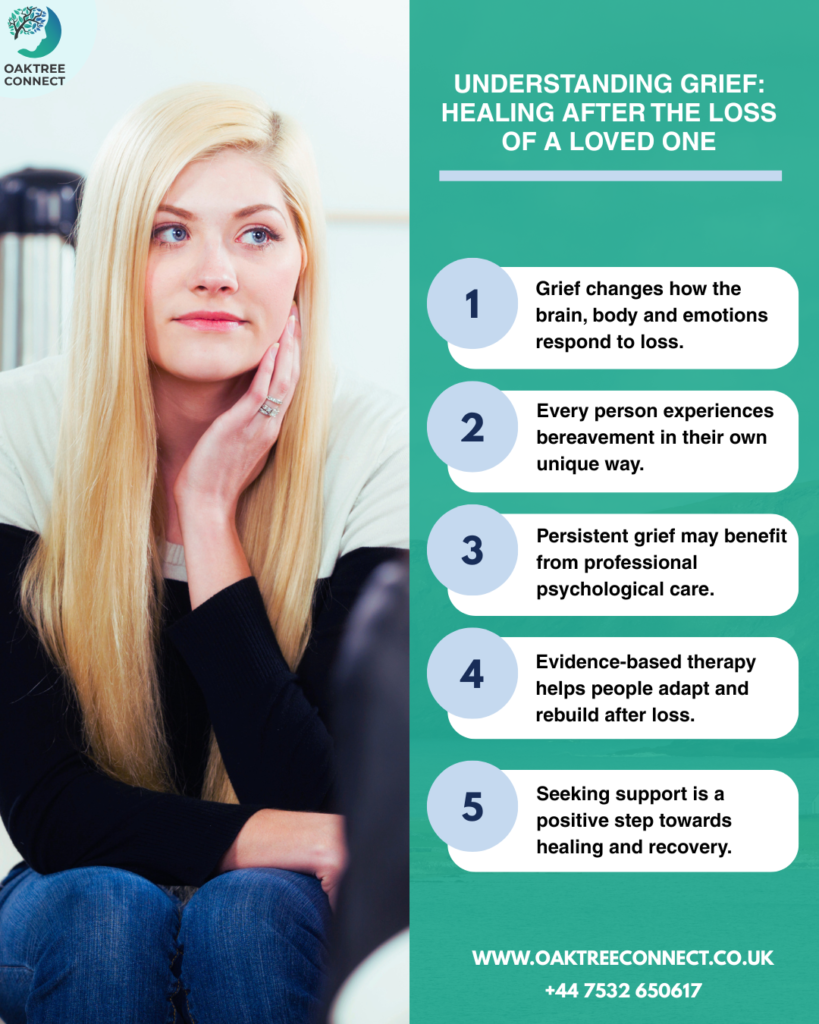
Although most people gradually adapt with the support of family, friends and community, psychological therapy can be transformative for the minority whose grief remains persistent and disabling.
A landmark review by Johannsen (2019), examined 31 randomised controlled trials, found that grief-focussed psychological interventions produced clinically meaningful improvements. And therapies designed specifically to address grief consistently outperformed general supportive counselling. Rather than encouraging people to ‘move on,’ these interventions help them process painful memories, reduce avoidance, challenge unhelpful beliefs such as feeling guilt for surviving and begin to reconnect with a meaningful future while maintaining a healthy continuing bond with the person who has died.
Among the therapies with the strongest evidence is Cognitive Behavioural Therapy (CBT), adapted specifically for grief. Grief-focussed CBT combines cognitive techniques with gradual exposure to painful memories or avoided situations, helping people integrate the reality of the loss into their lives. More recently, a 2024 randomised controlled trial led by Australian psychologist Richard Bryant compared grief-focussed CBT with mindfulness-based therapy for people diagnosed with Prolonged Grief Disorder. While both treatments reduced distress, CBT produced greater improvements in the core symptoms of prolonged grief, reinforcing its position as one of the most effective evidence-based treatments currently available. The aim of therapy, then, is not to erase grief or encourage forgetting, but to help people remember their loved one without remaining trapped in the moment of their loss.
The oldest community
One of the most enduring stories about grief comes from Buddhism. It tells of a young mother whose only child dies unexpectedly. Consumed by grief, she carries his body from house to house, begging for a medicine that will bring him back to life. Eventually she is directed to the Buddha, who agrees to help on one condition: she must fetch a handful of mustard seeds from a household that has never known death. Hopeful, she begins knocking on doors. Every family offers mustard seeds, yet every conversation reveals: a father has died, a grandmother has died, a child has died. She returns empty-handed. The Buddha does not remove her suffering; he shows her that she has joined the oldest community in human history.
Perhaps this is why almost every culture has developed rituals around death. Hindu mourning rituals guide families through cremation, prayer and remembrance. Buddhist chanting and acts of merit-making acknowledge both impermanence and compassion. Irish wakes, meanwhile, refuse to separate sorrow from laughter, bringing family and neighbours together to share stories, food, music and memory. Across cultures, these traditions perform a similar psychological function. They offer structure when the world has lost its shape and remind us that grief, however lonely it feels, has never been carried alone.
Not every grief, however, fits comfortably into the stories we tell about love. The death of an abusive parent, an estranged sibling or a difficult spouse can produce emotions that seem impossible to reconcile. Sadness may exist alongside relief, anger beside gratitude, and guilt alongside a sense of release. We may grieve not only the person who died but also the relationship we never had, or the reconciliation that will now never come. Psychologists describe these experiences as complicated or ambiguous grief, recognising that the loss is as much of possibility as of a person. Feeling relief does not mean we loved too little. Human relationships are rarely tidy, and neither is mourning them.
We do not get over grief so much as grow around it. Moving on may feel like a country we cannot yet imagine visiting, but with time the world slowly becomes recognisable again.
I do not think of grief as a wound that simply closes over time, but as a jagged shard of broken glass thrown into the sea. At first it catches on everything. Then the tides keep returning, smoothing its edges until it becomes seaglass, recognisably the same piece, but one that can finally be held without injury. Life continues to wash around the loss. Love remains. The pain changes shape.
When to seek help
There is no timetable for grief, nor the right way to mourn. Equally, there is no prize for struggling alone. If, months after a bereavement, your grief continues to make it difficult to work, maintain relationships, care for yourself or find moments of respite, it may be worth speaking to a mental health professional. Persistent sleep disturbance, overwhelming guilt, emotional numbness, increasing social withdrawal, reliance on alcohol or drugs, or a sense that life has permanently lost its meaning are all signs that additional support could be helpful.
An assessment does not mean your grief is being medicalised. Its purpose is to understand whether you are experiencing an expected response to loss, Prolonged Grief Disorder, depression, post-traumatic stress disorder or another condition that may benefit from treatment. Seeking help is not a sign that you are grieving incorrectly; it is simply another way of caring for yourself.
References
Bowlby, J. (1969). Attachment and Loss, Vol. 1: Attachment. London: Hogarth Press
Bowlby, J. (1980). Attachment and Loss, Vol. 3: Loss: Sadness and Depression. London: Hogarth Press
Coan, J. A., Schaefer, H. S., & Davidson, R. J. (2006). Lending a hand: Social regulation of the neural response to threat. Psychological Science
Lundorff, M., Holmgren, H., Zachariae, R., Farver-Vestergaard, I., & O’Connor, M. (2017). Prevalence of prolonged grief disorder in adult bereavement: A systematic review and meta-analysis. Journal of Affective Disorders
Stroebe, M., & Schut, H. (1999). The Dual Process Model of Coping with Bereavement: Rationale and Description. Death Studies
Zisook, S., & Shear, K. (2009). Grief and bereavement: What psychiatrists need to know. World Psychiatry
Bryant, R. A., et al. (2024). Cognitive Behavior Therapy vs Mindfulness for Prolonged Grief Disorder. JAMA Psychiatry
Johannsen, M., Damholdt, M. F., Zachariae, R., Lundorff, M., Farver-Vestergaard, I., & O’Connor, M. (2019). Psychological interventions for grief in adults: A systematic review and meta-analysis of randomized controlled trials. Journal of Affective Disorders
Disorder Related Blogs
- Anorexia Nervosa: Recognise the Quiet Killer
- Patient Talk - What Does Severe Clinical Depression Feel Like?
- Dear Mum: A Story by an Oaktree Patient with Depression
- SCHIZOPHRENIA – A Poem
- Autism: Dispelling Myths
- Mental Fitness: “I Have an Addiction”
Lifestyle Related Blogs
- Preventing Online Burnout
- Sad at Christmas? Help Is at Hand
- Burnout at Work
- Mental Fitness: How to Beat Stress
- Mental fitness: Brain Stimulation Therapy
- Mental Fitness: When Should You Stop Driving?
- Mental Fitness: “Let Us Talk About It”
- How to Combat Work-Related Stress
- Foods that make you happy
- Business Spending on Mental Health, Worth it?
- Employers Need More Awareness of Mental Health Issues
Other Blogs
Are you a leader and need mentoring or coaching? We may be able to help. Contact us at contact@oaktreeconnect.co.uk.

Author: Dr Meetu Singh
Dr Singh is the consultant psychiatrist with a special interest in neuropsychiatry. Having seen and treated hundreds of patients with ADHD, in London and Birmingham and with masters in Neuropsychiatry, she is well known as an expert in this field.
Contact:
Email – clinicadmin@oaktreeconnect.co.uk
Telephone – 020 39277699
Recent Blogs







Oaktree Connect Fees & Pricing for Other Services
There may be additional fees payable after your assessment, for which you will receive an invoice: for example, for the costs for prescribing medication agreed between you and the psychiatrist at the time of assessment. We try our utmost to stay within the time allocated for the appointment however, you could be charged for any extra time spent in the consultation, if the meeting runs over the allocated time, or where communications with you or reviewing notes etc. exceeds what is deemed reasonable, but this is at the discretion of the clinician.